Every dollar spent on truck PM service saves $4–$8 in emergency repairs, towing, and lost revenue. Yet 70% of fleet managers still operate reactively — fixing trucks after they break down on I-40, rather than scheduling the $800 service that would have caught the failing turbo three weeks earlier. The 2026 numbers tell the story bluntly: structured PM programs deliver 300–500% ROI, cut breakdowns 70%, extend vehicle life 20%, and save $15,000–$25,000 per truck annually. The fleets winning in 2026 aren't running newer trucks — they're running the same trucks with better service discipline.
A truck PM service is more than an oil change. It's a structured, scheduled, technician-performed inspection-and-replacement process designed to catch wear before it becomes failure, replace consumables before they degrade, and document every action against the asset's permanent maintenance history. Modern PM service blends mileage-based, time-based, and engine-hour triggers — taking whichever comes first — and ties directly into telematics, DVIR feedback, and fault code data. Done right, it transforms maintenance from a cost center into your fleet's most valuable financial lever.
This guide walks through what a truck PM service actually includes, how the trigger system works, the 4 service tiers (PM-A through PM-D), the technician procedure step by step, and how PM automation software eliminates missed services entirely. Start your free trial to automate your entire PM schedule.
Preventive Maintenance / 2026 Complete Guide
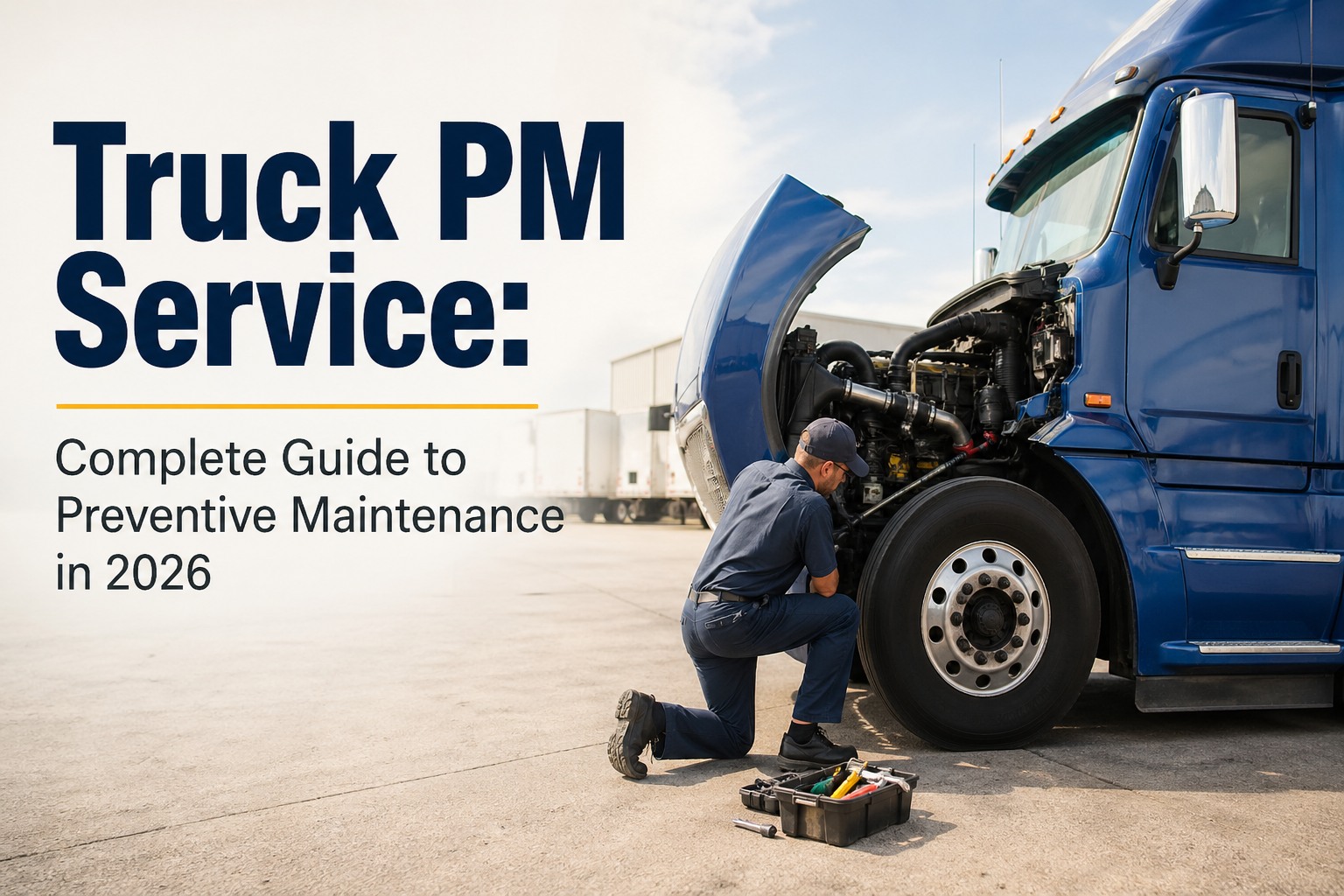
Truck PM Service: Complete Guide to Preventive Maintenance in 2026
From PM-A oil changes to PM-D overhauls — what every fleet manager needs to know about modern truck preventive maintenance, the 2026 service intervals, and the platform that automates the whole program.
2026 PM ROI Numbers
$4–$8
Saved per $1 of PM spend
70%
Fewer unplanned breakdowns
300–500%
Typical first-year ROI
$15K–$25K
Annual savings per truck
Quick Answer: What Is a Truck PM Service?
DEFINITION
A truck PM service (Preventive Maintenance service) is a scheduled, technician-performed maintenance procedure that inspects, lubricates, and replaces wear components at fixed intervals — before they fail. Unlike daily DVIR inspections (driver-performed) or reactive repairs (failure-driven), PM service follows a planned schedule based on mileage, engine hours, or calendar time, with the trigger that arrives first activating the service. Modern PM service is organized into four tiers — PM-A (basic, 10K–15K mi), PM-B (intermediate, 25K–45K mi), PM-C (major, 50K–100K mi), and PM-D (overhaul, 250K+ mi) — each level cascading on top of the previous. The 2026 best-practice PM program ties intervals to telematics data, auto-generates work orders, and documents every procedure for FMCSA compliance under 49 CFR §396.3.
The 3-Trigger Scheduling System
The biggest mistake legacy PM programs make: scheduling everything by calendar date. A truck running 30,000 miles a month doesn't belong on the same oil interval as one parked for two weeks. Modern PM service uses three triggers and acts on whichever comes first — that's how you avoid both over-servicing and under-servicing. Contact our support team to configure multi-trigger scheduling for your fleet.
◉
Mileage-Based
Best for: Long-haul, OTR trucks
Service triggers at fixed odometer intervals — oil at 15K, transmission at 50K. Works perfectly for over-the-road trucks accumulating consistent miles. Telematics auto-syncs odometer to PM scheduler.
Watch out: Misses high-idle vehicles that wear without adding miles
◆
Engine-Hours-Based
Best for: Construction, yard trucks, idling
Service triggers on cumulative engine run-time. Critical for vehicles that idle heavily, run PTO, or operate stationary equipment. A truck idling 6 hours a day accumulates engine wear without odometer changes.
Watch out: Long-haul trucks may not need hour-based intervals
▲
Calendar / Time-Based
Best for: Fluids, seasonal items, compliance
Service triggers every 30, 60, or 90 days regardless of usage. Essential for fluids that degrade over time, seasonal inspections, and regulatory compliance deadlines like annual DOT certification.
Watch out: Wastes service on low-mileage vehicles if used alone
★
Best practice: Use ALL THREE triggers simultaneously. Schedule "PM-A every 15,000 miles OR 250 engine hours OR 90 days, whichever comes first." This ensures no truck slips through the cracks regardless of duty cycle.
What's Actually Included in Each PM Tier
Each PM tier cascades on the one before it — PM-B includes everything in PM-A, PM-C includes PM-B, PM-D includes PM-C. This structure prevents duplicate work and creates a predictable service rhythm.
PM-A
Every 10,000–15,000 mi · 250 hrs · 90 days
Shop time: ~2 hours
Basic Service
• Engine oil & oil filter change
• Chassis lubrication (all grease points)
• Tire pressure check & tread depth
• Visual brake inspection
• Fluid top-offs (coolant, washer, DEF)
• Lighting & electrical system check
• Belt & hose visual inspection
Typical cost: $150–$300
PM-B
Every 25,000–45,000 mi
Shop time: ~4–6 hours
Intermediate Service
+ Everything in PM-A
• Fuel filter replacement
• Air filter replacement
• Brake adjustment & measurement
• DEF system inspection
• Differential & axle service
• Steering & suspension check
Typical cost: $400–$700
PM-C
Every 50,000–100,000 mi
Shop time: ~8–12 hours
Major Service
+ Everything in PM-A & PM-B
• Transmission fluid & filter
• Cooling system flush
• Power steering service
• U-joints & drivelines
• Wheel bearing inspection
• Alignment check
Typical cost: $1,200–$2,500
PM-D
Every 250,000+ mi · annually
Shop time: ~16–24 hours
Overhaul Inspection
+ Everything in PM-A, B & C
• Engine compression test
• Transmission deep inspection
• Frame & body corrosion audit
• Turbocharger inspection
• Emissions system service
• Full DOT re-certification
Typical cost: $3,500–$8,000+
The PM Service Procedure: Step-by-Step
Here's what actually happens when a truck arrives for PM service. The 7-step procedure separates a real PM from a glorified oil change — every step is documented, photographed, and saved to the asset's permanent maintenance record.
01
Pre-Service Intake & History Review
Technician pulls truck history — last PM date, current odometer, open DVIR defects, recent fault codes. Driver complaints reviewed. Time: 5–10 minutes.
Output: Service plan tailored to vehicle history
02
Walk-Around Inspection
Visual inspection of exterior, undercarriage, tires, lighting, body damage, fluid leaks. Photos taken of any defects. Active warning lamps logged.
Output: Defect list with photo evidence
03
Fluid & Filter Service
Drain & replace engine oil, replace filters per tier (oil, fuel, air, hydraulic, DEF as applicable). Top off coolant, washer fluid, DEF. Sample oil for analysis if program in place.
Output: Used parts logged, fluids documented
04
Mechanical Inspection & Measurement
Brake pad/lining measurement, slack adjuster check, tire tread depth, suspension play, steering linkage, U-joints. Measured values logged — not just "OK/Not OK."
Output: Quantified wear data per component
05
Diagnostic & Telematics Review
Scanner connected to read active and historic fault codes. Telematics data reviewed for hard-braking events, idle time, fuel efficiency trends since last PM. Issues addressed during service.
Output: Fault codes documented & cleared
06
Repair Defects Found & Open DVIRs
Any defect identified during inspection (or carried over from driver DVIRs) gets repaired during the PM window — not deferred to "next time." Defect-to-repair loop closes here.
Output: All defects certified per §396.11
07
Documentation & Sign-Off
Full work order completed: parts and labor logged with cost, photos attached, technician signature, mileage at service, next-service trigger calculated. Driver notified vehicle is ready.
Output: Audit-ready record permanently archived
Run Every PM Procedure on the Same Platform
Auto-triggered work orders, mobile inspection forms, photo evidence, parts/labor tracking, audit-ready records. The 7-step procedure becomes one digital workflow.
The Real ROI: Where Savings Come From
The 300–500% ROI on PM programs isn't marketing math — it's the sum of six specific cost reductions. Here's where each dollar of savings actually originates. Sign up free for 3 trucks to track these savings against your fleet baseline.
$4–$8
Repair Avoidance
Every $1 of PM spend prevents $4–$8 in emergency repair costs. A scheduled $800 brake service prevents a $4,500 roadside replacement.
70%
Breakdown Reduction
Structured PM cuts unplanned breakdowns by 70%. Each avoided breakdown saves $2,400+ in towing, premium parts, and lost revenue.
20%
Vehicle Lifespan Extension
Properly maintained trucks last 300,000+ more miles than neglected ones. Direct CapEx deferral and TCO reduction.
5–10%
Fuel Economy Gain
Clean filters, proper tire pressure, fresh oil, tuned engines burn less fuel per mile. Compounds across every truck, every shift.
5–10%
Resale Value Premium
Trucks with documented PM history sell for 5–10% more than identical undocumented vehicles. Records protect asset value.
$15K–$25K
Total per Truck/Year
Combined annual savings per truck across all six categories. For a 50-truck fleet, that's $750K–$1.25M back to the bottom line.
Spreadsheet PM vs Software-Automated PM
The difference between fleets running PM on spreadsheets and fleets running PM on automation software is the difference between "we tried" and "it worked." Here's what changes when the schedule lives in software instead of a tab.
Manual / Spreadsheet
Legacy Mode
Schedule triggerManual lookup
Odometer sourceDriver report
Missed PM rate15–25%
PM compliance68%
Records storagePaper / file cabinet
Audit prep time3–5 days
Defect-to-WOVerbal handoff
Defects slip through. ROI never materializes.
Software-Automated
2026 Mode
Schedule triggerMulti-trigger auto
Odometer sourceTelematics auto-sync
Missed PM rate< 5%
PM compliance94%+
Records storageCloud, permanent
Audit prep timeUnder 2 minutes
Defect-to-WOAuto work order
Full ROI captured. 95%+ uptime.
5 Common PM Mistakes That Kill ROI
Even fleets running PM programs leak savings through these five recurring mistakes. Each one is fixable — and the fix usually pays for itself within 60 days. Talk to our support team to audit your current PM program for these gaps.
01
Calendar-only scheduling
A 90-day oil interval makes no sense for a truck driving 30,000 miles in 30 days vs one that drove 2,000 miles in 90.
Fix: Multi-trigger scheduling — mileage OR hours OR time, whichever first.
02
Deferring PM to "save money"
Skipping a $150 coolant flush feels like savings until the $8,000 cylinder head replacement hits. Deferred PM costs 4–8× more.
Fix: Lock PM budget. Treat as fixed cost, not discretionary.
03
Same intervals across all trucks
Refuse trucks running stop-and-go wear at 2× the rate of long-haul. Generic intervals over-service some, under-service others.
Fix: Duty-cycle profiles — severe-duty intervals for high-stress vehicles.
04
Not tracking what was actually done
"PM completed" with no record of measurements, parts, or technician sign-off creates audit risk and warranty claim denials.
Fix: Digital work orders with quantified data per service.
05
No KPI tracking
Without PM compliance %, MTBF, and breakdown frequency tracked monthly, you can't tell if the program is working or quietly failing.
Fix: Live dashboard with PM compliance, downtime, cost-per-mile.
Frequently Asked Questions
How often should I perform PM service on a Class 8 truck?+
Standard tiered schedule: PM-A every 10,000–15,000 miles (basic service), PM-B every 25,000–45,000 miles (intermediate), PM-C every 50,000–100,000 miles (major), PM-D at 250,000+ miles or annually (overhaul). Severe-duty applications (construction, stop-and-go delivery, extreme climates) shorten these intervals 30–50%. Always cross-reference with your engine OEM's recommendation. Sign up free to apply tier intervals to every truck in your fleet.
What's the actual ROI on a structured PM program?+
2026 industry data shows 300–500% ROI in the first 12 months. The savings break down as: $4–$8 saved per $1 of PM spend (repair avoidance), 70% fewer breakdowns, 20% longer vehicle lifespan, 5–10% fuel economy gain, 5–10% resale premium. The average fleet saves $15,000–$25,000 per truck per year. Most programs pay for themselves within 30–90 days through avoided emergency repairs alone.
Should I schedule PM by mileage, hours, or calendar time?+
All three — and trigger the service on whichever arrives first. Long-haul OTR trucks lean on mileage, construction equipment on engine hours, and time-based triggers cover fluids that degrade in storage and regulatory deadlines. Modern PM software handles multi-trigger scheduling automatically, so no truck slips through gaps. Contact our support team for help configuring multi-trigger schedules across your fleet.
What records do I need to keep for FMCSA compliance?+
Under 49 CFR §396.3, every fleet must document inspections, repairs, and maintenance for each vehicle, including vehicle ID, work performed, date, and odometer reading. Retention minimums: DVIRs 3 months, annual DOT inspection records 14 months, general maintenance records 1 year while in service plus 6 months after disposal. Digital systems with automatic retention satisfy all FMCSA requirements and turn audit prep from days into minutes.
What's the difference between PM service and predictive maintenance?+
Preventive (PM) runs on fixed schedules — service at X miles regardless of actual condition. Predictive maintenance uses telematics, AI, and sensor data to forecast failures and service components only when needed. The 2026 best practice combines both: PM as the baseline foundation, predictive layered on top for high-value components like engines, transmissions, and turbochargers. Predictive can reduce maintenance costs another 34% on top of PM savings.
Can I run PM service in-house, or should I outsource?+
The hybrid model wins for most fleets. Keep high-frequency, low-complexity work in-house (PM-A oil and filter services) and outsource specialized work (engine rebuilds, transmission overhauls, alignments). Smaller fleets without shop facilities outsource everything to a partner shop. Larger fleets with in-house technicians save 10–20% on labor by doing routine PM internally. Start your free trial to track in-house and vendor PM costs in one platform.
PM Service Done Right. Every Truck. Every Mile. Every Time.
Automate Your Entire PM Program in One Platform
Multi-trigger scheduling, auto-generated work orders, mobile inspection forms, parts/labor tracking, and FMCSA-ready documentation. See how 500+ fleets cut breakdowns 70%, extend vehicle life 20%, and save $15K–$25K per truck per year.
No credit card required. Free for up to 3 trucks. PM templates included.