Fleet managers ask the same question every week: "We inspect every truck daily — why are we still getting roadside breakdowns?" The answer is almost always the same. Inspections find defects. Maintenance fixes them. The gap between those two is where money disappears, audits fail, and trucks break down on the side of I-80. According to ATRI, unplanned downtime costs $760 per day per truck — and most of those breakdowns trace back to a defect that was caught in a DVIR but never made it into a work order.
Inspection and maintenance are two distinct functions with two different owners — drivers do one, shops do the other — connected by a single legal bridge: the Driver Vehicle Inspection Report (DVIR) under 49 CFR §396.11. When that bridge works, defects flow into work orders, repairs get documented, and trucks return to service compliant. When the bridge breaks, defects get scribbled on paper, lost in dispatch, or verbally relayed to a tech who's already on another job. The 50-truck fleet running on disconnected paper processes spends roughly $200,000 a year more than the fleet running both in one platform.
This guide explains the difference between inspection and maintenance, how DVIR legally bridges them, what the connected workflow looks like, and the KPIs that prove your handoff is working. Start your free trial to digitize the bridge between inspections and work orders.
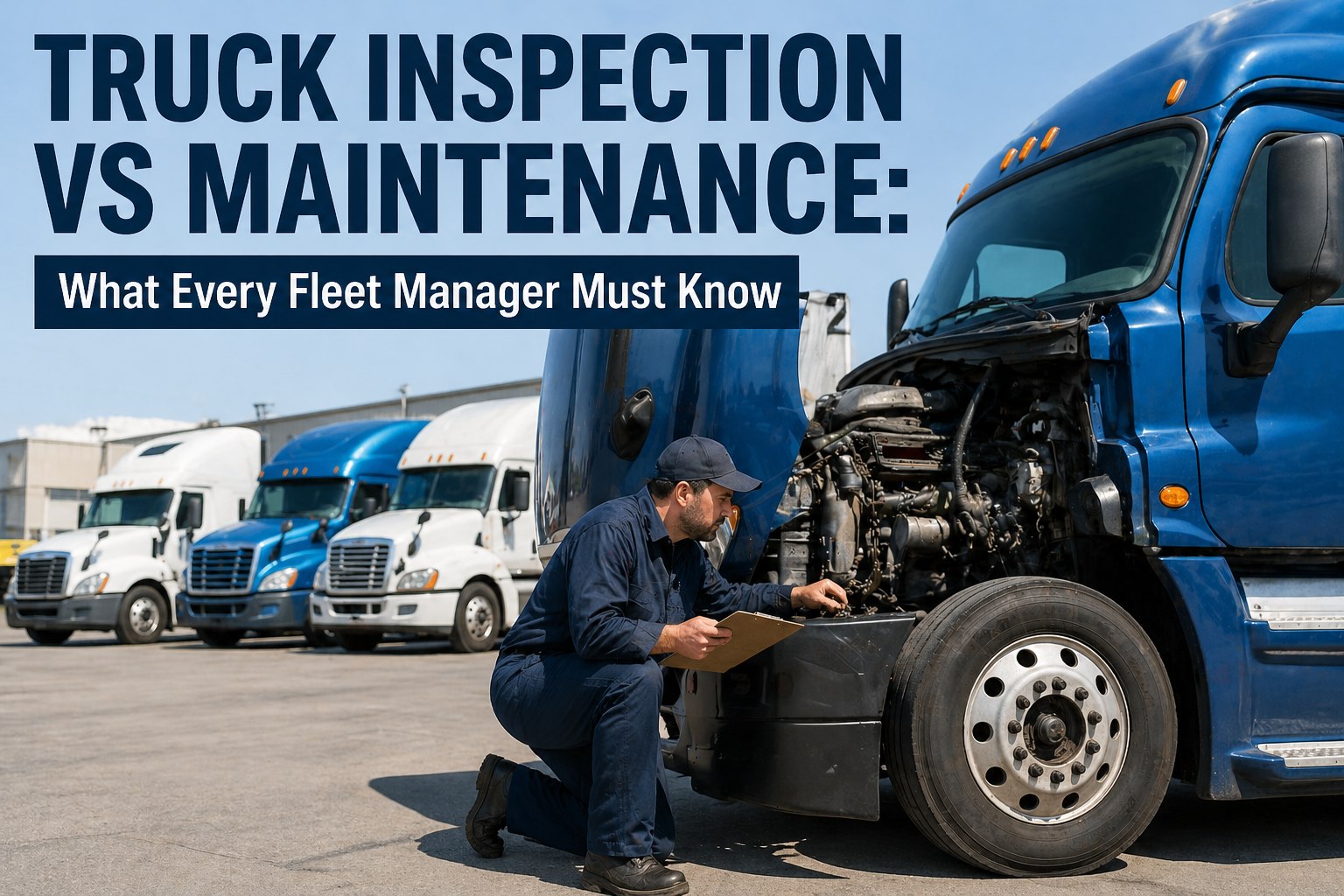
Truck Inspection vs Maintenance: What Every Fleet Manager Must Know
Two functions, one legal bridge, and the gap between them is where money disappears. Decode the difference between DVIR and PM, and learn how connected platforms eliminate the handoff failures that cost $760/day per truck.
DVIR §396.11
Quick Answer: Inspection vs Maintenance
Truck inspection is the act of examining a vehicle to identify defects, wear, or compliance issues — performed daily by drivers (DVIR), at intervals by technicians (PM inspections), and annually by certified inspectors (DOT). Truck maintenance is the act of repairing or replacing components — performed by technicians through scheduled preventive maintenance (PM A/B/C/D services) and corrective work orders triggered by inspection findings. The two are connected by the DVIR (49 CFR §396.11), which legally requires carriers to document any safety-affecting defect and certify the repair before the vehicle returns to service. Inspections find problems; maintenance fixes them. Modern fleets connect both into one digital workflow so defects flow automatically from DVIR into work orders.
The Core Differences at a Glance
Most fleet managers know inspection and maintenance "are different" — but the operational difference goes deeper than who does the work. Different owners, different cadences, different documentation, different failure modes. Contact our support team to map your current workflows against the framework below.
§396.11
The 3 Inspection Types Every Fleet Runs
Not all inspections are the same. Three distinct types run in parallel — different cadences, different inspectors, different goals. Together they form the early-warning system that feeds your maintenance workflow.
The 4 Maintenance Types That Follow
Once inspection finds the issue, maintenance gets the work. Four distinct categories of maintenance work alongside each other in a properly run fleet — different triggers, different priorities, different costs.
The DVIR: The Legal Bridge Between Both
The Driver Vehicle Inspection Report is more than paperwork — it's the document FMCSA uses to enforce the connection between inspection and maintenance. Every safety-affecting defect identified during a DVIR must be repaired and certified before the vehicle returns to service.
What "Connected Workflow" Actually Looks Like
The 7-stage flow below is what separates fleets running 95%+ uptime from fleets fighting fires daily. Each stage triggers the next automatically — no verbal handoffs, no lost paper, no defects forgotten between dispatch and shop. Sign up free for 3 trucks to run this exact workflow on your fleet.
Disconnected vs Connected: The Real Cost Gap
Two fleets, same trucks, same drivers, same routes — but one runs inspection and maintenance on disconnected paper systems while the other runs both in one platform. Here's what that 12-month difference looks like for a 50-vehicle fleet. Talk to our support team to see your fleet's specific cost gap calculated.
5 KPIs That Prove Your Bridge Is Working
You can't improve what you can't measure. These five KPIs reveal whether inspection and maintenance are actually connected — or whether defects are silently dying between DVIR and work order.
Frequently Asked Questions
"Inspection" is the broad term — it covers driver pre-trip, technician PM inspections, and annual DOT certifications. The DVIR (Driver Vehicle Inspection Report) is specifically the document the FMCSA requires under 49 CFR §396.11 — every commercial driver must complete it at the end of every shift, listing safety-affecting defects, and the carrier must certify repairs before the vehicle goes back into service. All DVIRs are inspections; not all inspections are DVIRs. Sign up free to digitize DVIRs across your fleet.
Yes — and this is the entire ROI argument. Modern fleet management platforms unify driver DVIR submissions, PM scheduling, work order generation, parts/labor tracking, and DOT compliance documentation in one system. Defects identified in a DVIR auto-create work orders. PM intervals trigger work orders by mileage or date. Every record connects to the same asset history. The split between inspection software and maintenance software is a legacy artifact — not a real architectural requirement.
FMCSA minimums: DVIRs retained for 3 months, maintenance records for 1 year while vehicle is in service plus 6 months after disposal, and annual DOT inspection records for 14 months. Best practice for audit defense: digital storage of all records permanently. Cloud-based platforms make this free, eliminate paper losses, and produce audit-ready exports in minutes. Contact our support team for retention-policy templates.
No — and this is where many fleets get confused. Drivers do daily DVIRs (safety-affecting items they can see and feel from the cab and walk-around). PM inspections happen at scheduled intervals and require shop equipment, measurement tools, and technician training — brake stroke measurements, suspension play tests, internal component inspections drivers can't perform. The two work together but have different scopes. Best programs do both layered.
Verbal handoffs and physical paperwork lose 12–18% of defects between driver and shop. Paper DVIRs get filed before reaching the tech, defects get communicated verbally and forgotten, photos can't be attached, severity isn't standardized, and there's no audit trail showing when a defect was reported vs repaired. Digital DVIRs eliminate every one of those failure points — the defect goes from driver's phone to shop dashboard in real time. Sign up free to digitize the bridge.
Most fleets see 3.5× ROI within 12 months. The savings come from four sources: reduced unplanned downtime ($760/day per truck recovered), faster defect-to-repair cycles (3 days → 4 hours), higher PM compliance (68% → 94%), and audit prep time (3-5 days → 2 minutes). On a 50-truck fleet, that's roughly $200,000+ in annual savings — before counting insurance premium reductions from documented safety. Contact our support team to model your fleet's specific savings.
Run Inspection & Maintenance in One Connected Platform
Digital DVIR, auto-generated work orders, PM scheduling, parts tracking, and DOT-ready compliance — all flowing through the same system. See how 500+ fleets close the gap that costs disconnected fleets $200K+ a year.