The right engine oil can extend your truck's engine life by 200,000+ miles. The wrong one can turn a $12,000 top-end rebuild into a $45,000 in-frame overhaul — and void the warranty that would have covered both. With more than 3.5 million heavy-duty trucks on American roads and every major OEM (Cummins, Detroit Diesel, Volvo, PACCAR) now factory-filling with 10W-30 instead of the legacy 15W-40 standard, the oil-selection conversation has shifted dramatically in the last five years. Knowing the difference between viscosity grades, API classifications, and base-oil types isn't mechanic trivia anymore — it's a financial decision that repeats itself every 25,000 miles.
This guide decodes exactly what those numbers on the oil jug mean, compares 15W-40 vs 10W-30 across real operating conditions, explains the API CK-4 vs FA-4 classification system that determines warranty compatibility, and breaks down conventional vs synthetic blend vs full synthetic oils so you pick the right one for your fleet's duty cycle and climate. Start your free trial to track oil changes, intervals, and engine health per truck.
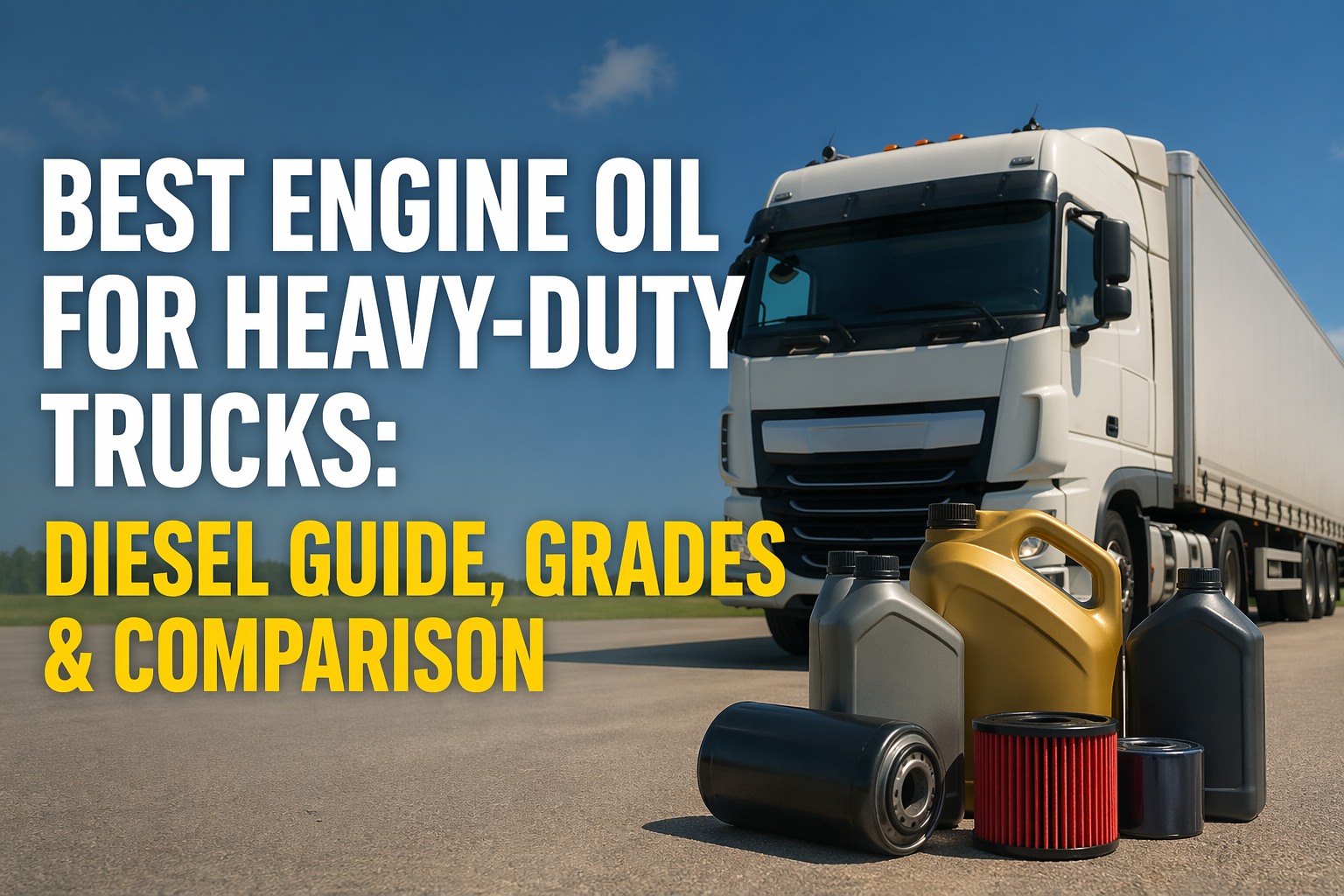
Best Engine Oil for Heavy-Duty Trucks: Diesel Guide, Grades & Comparison
15W-40 vs 10W-30, CK-4 vs FA-4, conventional vs synthetic — decoded for fleet managers. Pick the right oil for your climate, duty cycle, and engine generation, and save $400–$800 per truck per year.
Quick Answer: What Is Heavy-Duty Engine Oil?
Heavy-duty engine oil (HDEO) is a specialized motor oil formulated for diesel engines in commercial trucks, designed to handle the extreme heat, soot, acid, and load stress of continuous high-mileage operation. HDEO differs from passenger-car oil in three critical ways: it contains higher detergent and dispersant additives to manage diesel-specific contamination, meets American Petroleum Institute (API) CK-4 or FA-4 service categories rather than passenger "S" categories, and is available in multi-grade viscosities optimized for heavy-duty duty cycles — most commonly 15W-40 (legacy standard) and 10W-30 (modern fuel-economy grade).
Oil Grade Decoder: What The Numbers Actually Mean
Every multi-grade oil label — 15W-40, 10W-30, 5W-40 — follows the same naming convention defined by the Society of Automotive Engineers (SAE). Once you decode it, picking the right grade becomes mechanical instead of confusing. Contact our support team for help matching grades to your specific engine generation.
15W-40 vs 10W-30: The Complete Comparison
Both oils are multi-grade, both meet API CK-4, and both have hundreds of thousands of fleet miles behind them. The difference shows up in cold-start performance, fuel economy, and how well each matches modern engine tolerances. Here's the head-to-head breakdown.
API Service Categories Decoded
The American Petroleum Institute classification on every HDEO label determines warranty compatibility, emissions-system protection, and performance tier. CK-4 is the current mainstream standard — but knowing what each tier covers helps you avoid mismatches that void warranties or damage DPF/SCR systems.
Which Oil For Your Operation?
Match the oil to the engine, climate, and duty cycle — not to what's on the shelf. Here's the fleet-tested decision matrix that maps common scenarios to the right grade and base-oil choice.
| Your Operation | Recommended Grade | Base Oil | Why |
|---|---|---|---|
| Modern long-haul (2017+ engines) | 10W-30 CK-4 | Synthetic blend or full | OEM spec, fuel economy, cold-start protection |
| Older fleet (pre-2017, 150K+ miles) | 15W-40 CK-4 | Conventional or blend | Higher film strength fills worn clearances |
| Cold-climate operation (< 20°F winters) | 10W-30 or 5W-40 CK-4 | Full synthetic | Superior cold-start flow prevents startup wear |
| Hot-climate, heavy haul (desert SW) | 15W-40 CK-4 | Synthetic blend | Thicker film stays intact under sustained heat |
| Urban delivery, stop-and-go | 10W-30 CK-4 | Synthetic blend | Fast cold starts every shift, modest fuel gains |
| Extended-drain program (40K+ mi) | 10W-30 FA-4 or CK-4 | Full synthetic | Only full synthetic sustains that interval |
| Maximum fuel economy priority | 10W-30 FA-4 | Full synthetic | FA-4 specifically engineered for fuel savings |
| Warranty-critical new trucks | Follow OEM spec exactly | OEM recommended | Deviation can void manufacturer warranty |
6 Signs Your Oil Needs Changing Now
Interval tracking catches most changes on schedule, but these warning signs tell you to swap oil before the next interval — ignoring them turns a $200 oil change into a $4,000 top-end repair. Talk to our support team to set up automated oil-interval alerts for your fleet.
Frequently Asked Questions
In most cases, yes — provided the 10W-30 meets the API service category your engine requires (usually CK-4, which is backward compatible to CJ-4 and CI-4 PLUS). However, engines with 150,000+ miles often benefit from 15W-40's thicker film to compensate for worn clearances. When in doubt, check your engine manufacturer's approved oil list first. Sign up free to log which grade runs in each truck with age-and-mileage visibility.
Not if the replacement oil meets the manufacturer's specified viscosity grade and API service category. Deviating from OEM specs — either going to a non-approved grade or using a lower API tier — can absolutely void warranty coverage. Always check the owner's manual, and save purchase receipts and service records as proof of compliance. Contact our support team to see how digital oil-change records protect warranty claims.
Fleet studies and OEM testing consistently show 1–2% fuel economy improvement when switching from 15W-40 to 10W-30 of equivalent quality. For a truck running 100,000 miles per year at 6.5 MPG and $3.89/gallon diesel, that's $400–$800 in annual savings per truck. Fuel economy varies with driver behavior, routes, and loads — a proper fleet fuel-tracking system isolates the oil contribution from other variables.
Both are current API service categories for post-2017 diesel engines, but they serve different goals. CK-4 is the mainstream standard — enhanced protection, backward compatible with older engines, available in 15W-40 and 10W-30. FA-4 is a specialized fuel-economy formulation with lower high-temperature/high-shear viscosity, typically only in 10W-30 or 5W-30, and is NOT backward compatible. Use FA-4 only if your engine OEM specifically approves it.
Usually yes — but only when paired with oil analysis. Full synthetic HDEO can run 40,000–60,000+ miles safely in many applications vs 15,000–25,000 for conventional. However, extending intervals without lab analysis is a gamble. Send samples every 25,000 miles, track total base number (TBN) depletion, and only extend when the data supports it. Fleets doing this right save 30–50% on annual oil costs.
Less than marketing suggests, but more than pure skeptics claim. Any oil meeting API CK-4 or FA-4 specs has been tested to the same performance standards. Premium brands often use better base stocks and additive packages within those specs, delivering measurably cleaner used-oil analysis results. For fleets running oil analysis, higher-quality oils typically justify their price through extended drain intervals. Start your free trial to track oil brand and analysis results per truck.
Track Every Oil Change, Grade, and Interval in One Platform
Automated odometer sync, oil-interval alerts, grade and cost logs per truck, and DOT-ready service records. See how 500+ fleets protect warranties, extend engine life, and lower cost-per-mile.