A single preventable truck accident costs fleets an average of $16,000 — and that number quadruples with injuries, exceeding $500,000 when a fatality is involved. The Federal Motor Carrier Safety Administration confirms that fleets running structured, consistent safety training programs cut preventable accidents by up to 40%. But here's the catch most fleet managers run into: building the training program is only half the battle. Tracking completions, tying them to DVIR workflows, documenting coaching sessions, and keeping every record audit-ready — that's where most programs quietly collapse.
Truck Inspection & Maintenance software closes that gap. Our platform unifies driver safety training tracking with pre-trip inspections, DVIR submissions, telematics-triggered coaching, and FMCSA-aligned compliance documentation — all in one system. No spreadsheets. No siloed training LMS disconnected from your inspection records. Just a single source of truth that keeps drivers trained, vehicles inspected, and your fleet audit-ready every day.
This guide walks through exactly what a modern truck driver safety training program needs to include — the core pillars, the 7-step implementation framework, FMCSA compliance requirements, essential training topics, and the KPIs that prove it's working. Start your free trial to see how our platform automates the entire workflow.
Fleet Safety / Driver Training Guide
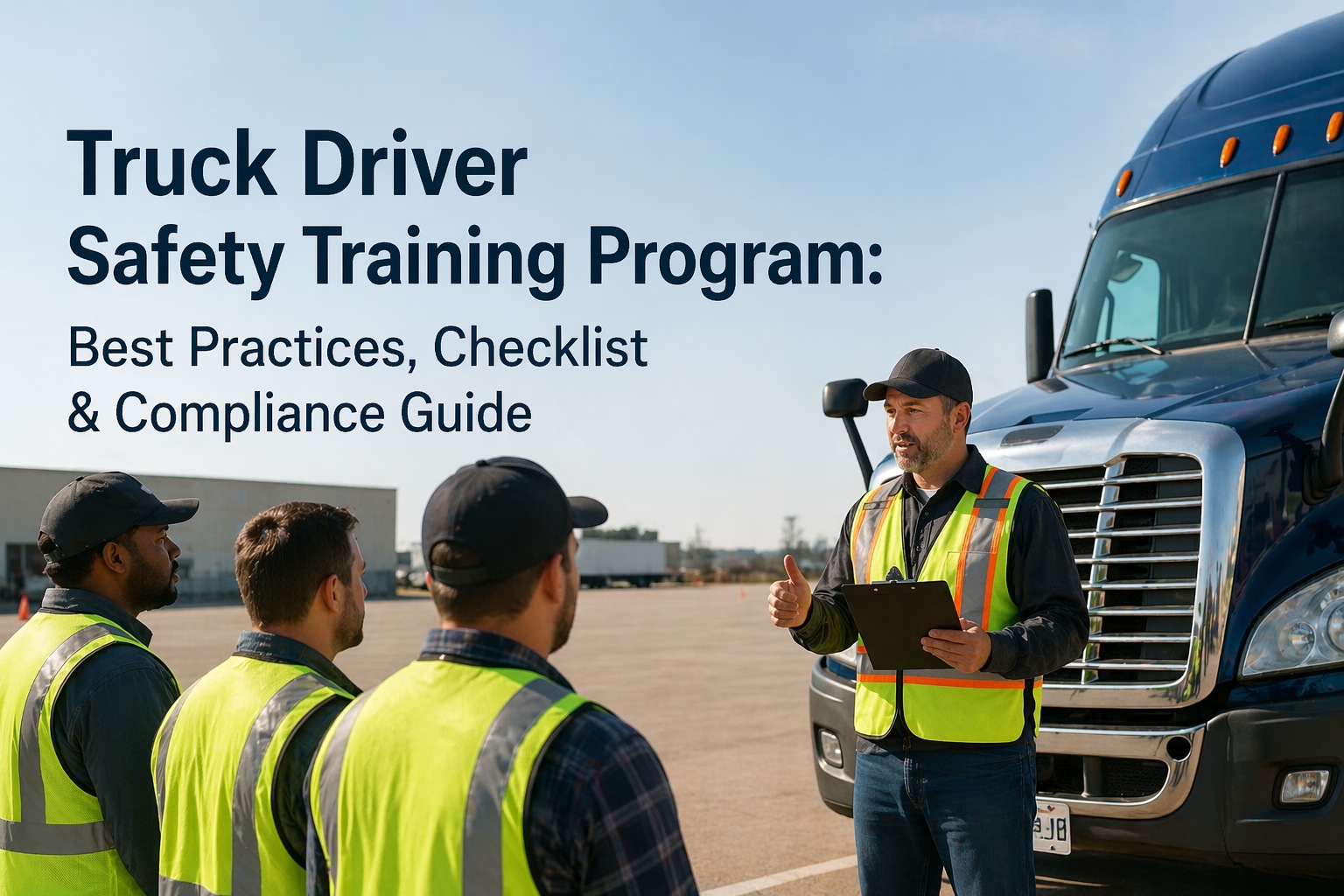
Truck Driver Safety Training Program: Best Practices, Checklist & Compliance Guide
Cut preventable accidents by up to 40% with a structured training program — and run the whole thing inside Truck Inspection & Maintenance software. Training, DVIR, compliance documentation, and coaching workflows in one platform.
500+ fleets managed
FMCSA aligned
Free for 3 drivers
The Real Cost of Untrained Drivers
Before investing in a training program, understand what you're actually preventing. The trucking industry absorbs roughly $60 billion annually in accident-related costs — damages, medical bills, legal fees, and operational disruption. Most incidents trace back to controllable behaviors that structured training addresses directly. Truck Inspection & Maintenance software turns that training into measurable, documented action — contact our support team to see exactly how incident data surfaces in your safety dashboard.
$16K
Average cost per preventable truck accident
Quadruples with injury. $500K+ with fatality.
823
Fatal injuries for heavy/tractor-trailer operators annually
Highest of any single occupation — BLS 2023
37%
Share of workplace deaths caused by transportation incidents
Leading cause of fatal worker injuries
40%
Accident reduction with consistent training programs
FMCSA-verified training outcome data
Top Causes of Truck Crashes (All Preventable With Training)
32%
Lane departure / running off road
Speed, distraction, fatigue
22%
Rear-end collisions
Following distance, brake awareness
18%
Distracted driving incidents
Mobile devices, in-cab distractions
14%
Fatigue-related crashes
HOS violations, poor scheduling
Core Pillars of an Effective Safety Training Program
Every high-performing driver safety program rests on six interconnected pillars. Remove any one and the program loses its ability to actually change behavior. Our Truck Inspection & Maintenance platform is built specifically to operationalize each of these pillars — turning training theory into tracked, documented outcomes.
◆
Pillar 01
Leadership Commitment
Safety culture starts at the top. Written policies, executive sponsorship, and measurable safety goals — all stored and distributed through the platform so every driver sees the company's commitment in writing.
Policy hubAccountability
●
Pillar 02
Defensive Driving Instruction
Teaches drivers to anticipate and compensate for other motorists' mistakes. Assign modules directly inside the platform, track completion by driver, and tie lesson topics to real telematics events on their route.
Assigned modulesTracked
■
Pillar 03
Regulatory Compliance
FMCSA Entry-Level Driver Training, HOS rules, DQ file requirements, and CDL endorsements. The platform stores every certificate, flags expirations, and keeps your documentation audit-ready every day.
ELDTFMCSADOT
▲
Pillar 04
Vehicle Inspection Proficiency
Pre-trip, post-trip, and en-route inspection competence. Drivers complete DVIRs in the mobile app, defects auto-create work orders, and inspection quality becomes a tracked training metric per driver.
DVIRMobile appAuto-WO
◉
Pillar 05
Continuous Coaching
One-time training doesn't stick. The platform connects to your telematics, triggers targeted coaching when hard braking or speeding events occur, and documents every session — with monthly microlearning built in.
TelematicsAuto-trigger
★
Pillar 06
Recognition & Incentives
Reward accident-free miles, clean inspections, and safe telematics scores. Built-in driver scorecards make top performers visible, fueling retention improvements of up to 85% in well-run programs.
ScorecardsLeaderboards
The 7-Step Training Framework (Built Into The Platform)
This is the implementation path we've seen work across fleets from 10 to 10,000 drivers. Each step is built into our Truck Inspection & Maintenance software as a workflow — so you're not bolting training onto your operations, you're running it as part of daily fleet management. Sign up free for 3 drivers to run the full 7-step workflow on your own fleet without a credit card.
01
Hiring & Pre-Employment Screening
MVR review, Drug & Alcohol Clearinghouse query, past-employer verification, road test. Store all of it inside the platform's driver profile — start the compliance trail from day one.
Platform output: Complete DQ file per 49 CFR §391.51
02
New-Hire Orientation
Company policies, emergency procedures, dispatch workflow, equipment familiarization. Assign orientation modules in the platform, collect e-signatures on policy documents, and flag incomplete onboarding before drivers hit the road.
Platform output: Signed policy acknowledgments, completion certificate
03
ELDT / CDL Compliance Training
For entry-level drivers obtaining CDLs post-February 2022: theory plus behind-the-wheel training via FMCSA-registered providers. Upload certificates directly to driver profiles so they're tied to every compliance record in the system.
Platform output: FMCSA Training Provider Registry certification stored
04
Defensive Driving & Hazard Recognition
National Safety Council curriculum or equivalent. Focus on space management, visual habits, adverse conditions, emergency maneuvers. Track completion percentage and quiz scores per driver inside the platform.
Platform output: Behind-the-wheel evaluation scored against rubric
05
Vehicle-Specific Inspection Training
Drivers learn pre-trip, post-trip, and roadside inspection procedures on the actual equipment they'll operate. Our DVIR mobile app walks drivers through the exact inspection flow — training and daily operations use the same tool.
Platform output: Demonstrated pre-trip completion under observation
06
Ongoing Refresher Training
Monthly microlearning modules (5–8 minute videos), quarterly deep-dives on high-risk topics, annual recertification. The platform auto-assigns modules, sends reminders, and flags overdue completions to supervisors.
Platform output: Documented training completion rate per driver
07
Corrective Action & Coaching
Triggered by telematics alerts, DVIR defects, or inspection violations. The platform automatically creates a coaching task, links it to the underlying event data, and records the resolution — creating the legal defensibility paper trail.
Platform output: Coaching logs, improvement plans, follow-up verification
Training Program Falling Apart in Spreadsheets?
Run your entire safety training program — assignment, tracking, DVIR integration, telematics coaching, and compliance documentation — inside one platform. See it working on your fleet in 15 minutes.
Essential Training Topics Checklist
These are the training modules every fleet should cover — organized by category. Use this as a gap analysis against your current program, and know that the platform can track completion across every single one of these topics per driver, with expiration alerts baked in.
✓Space management — 7-second following distance, mirror scanning every 5–8 seconds
✓Intersection navigation — left-turn squeeze, blind-spot awareness
✓Adverse weather driving — rain, snow, ice, fog, high wind
✓Speed management — curves, downgrades, construction zones
✓Night & fatigue driving — scanning techniques, recognizing drowsiness
✓Emergency maneuvers — brake failure, tire blowout, skid recovery
✓Hours of Service — 11/14/70-hour rules, sleeper berth provisions
✓ELD operation — log edits, malfunction reporting, RODS duty status
✓DOT inspection readiness — Level I–VI inspection procedures
✓Drug & Alcohol Clearinghouse — testing protocols, consequences
✓Hazmat handling — placarding, shipping papers (H-endorsement fleets)
✓CSA score awareness — how violations affect fleet ratings
✓Pre-trip inspection — 7-step walkaround covering 55+ points via mobile DVIR
✓Post-trip DVIR completion — defect reporting feeds directly into work orders
✓Tire condition assessment — tread depth, inflation, damage detection
✓Brake system checks — air brake procedures, slack adjuster inspection
✓Coupling & uncoupling — fifth wheel, air lines, safe procedures
✓Load securement — cargo tie-downs, weight distribution
✓Accident response — scene protection, documentation, reporting via app
✓Staged accident recognition — fraud awareness, evidence preservation
✓First aid basics — bleeding control, CPR, trauma stabilization
✓Distracted driving — phone policies, in-cab technology use
✓Driver wellness — sleep hygiene, nutrition, exercise on the road
✓Workplace violence prevention — de-escalation, personal security
FMCSA Compliance: What The Law Requires (And How The Platform Handles It)
Training isn't optional in most cases — federal rules mandate specific certifications, documentation, and record retention. Getting this wrong costs fleets up to $12,000 per driver in audit fines and can result in out-of-service orders. Truck Inspection & Maintenance software stores, flags, and reports on every one of these requirements automatically. Talk to our compliance team for a walkthrough of exactly how your DOT records would flow into the platform.
Since February 7, 2022, anyone obtaining a Class A/B CDL, upgrading Class B to Class A, or adding P/S/H endorsements must complete theory and behind-the-wheel training with an FMCSA-registered provider. Our platform stores every certificate, links it to the driver profile, and surfaces expiration alerts long before renewal dates hit.
Platform tracks:
Provider verification
Theory + BTW status
Record retention
Every motor carrier must maintain a complete DQ file — application, MVR, medical certificate, road test, annual review, Clearinghouse queries, and training records. DQ violations consistently rank in the top 10 audit findings, with penalties reaching nearly $12,000 per driver. Our platform centralizes every document with automated retention tracking.
Automated in platform:
Document retention
MVR reminders
Expiry alerts
HOS rules limit driving to 11 hours within a 14-hour on-duty window, with 10 consecutive hours off-duty required. Drivers must be trained on ELD operation, malfunction procedures, and HOS exemptions. The platform's training modules cover each rule, with completion tied to the driver's compliance record.
Training coverage:
11/14/70 rules
Split sleeper berth
Short-haul exceptions
Pre-employment, random, post-accident, reasonable suspicion, and return-to-duty testing requirements. Supervisors need 60 minutes of reasonable-suspicion training. The platform stores Clearinghouse query records, supervisor training certificates, and your policy distribution documentation — all tied to driver profiles.
Platform stores:
Clearinghouse queries
Supervisor training
Policy distribution
Best Practices That Actually Work (And How Software Enables Them)
Research across hundreds of fleets reveals the training techniques that produce measurable results — and the approaches that waste money. Truck Inspection & Maintenance software is designed around what works, removing the manual overhead that usually kills these practices before they scale.
Microlearning (5–8 min videos)
Assign bite-sized modules through the platform — drivers complete them on their phones during breaks. Higher retention, mobile-first, completion tracked automatically.
4-hour classroom marathons
Attention drops after 20 minutes. Drivers zone out, retain 10–15% of material, and resent the time commitment.
Telematics-triggered coaching
The platform integrates with your telematics so a hard braking or speeding event automatically creates a coaching task within 24 hours — while the event is still fresh.
Annual blanket retraining
Same module assigned to every driver regardless of performance. Good drivers bored, weak drivers unchanged.
Documented coaching sessions
Every coaching conversation logged in the platform — topic, date, driver response, follow-up actions. Creates the legal defensibility trail that protects the company if an incident later occurs.
Paper violation reports
Abstract citations with no context. Driver disputes details, no learning occurs, relationship degrades.
Recognition for clean records
Driver scorecards in the platform rank performers on inspection quality, on-time training completion, and telematics scores. Makes top performers visible — retention improves up to 85%.
Discipline-only culture
Drivers only hear from safety when something goes wrong. Creates adversarial dynamic, hides near-misses.
Integrated DVIR + training data
Our platform ties inspection quality to the driver record. A driver missing defects in DVIRs triggers targeted inspection-skill training — one seamless workflow, no data silos.
Siloed training LMS
Training system disconnected from inspections, maintenance, and telematics. Data never correlates, patterns never surface.
How to Measure Program Success
A training program without metrics is just a line item on an expense report. These are the KPIs that prove your investment is working — and every one of them is tracked automatically on the Truck Inspection & Maintenance dashboard, so leadership sees the ROI without manual reporting. Sign up and start tracking — your first driver scorecards populate within the day.
◆
Preventable Accident Rate
Accidents per million miles
Target: 40% reduction year-over-year
Dashboard trends this automatically from incident logs
●
CSA BASIC Scores
Unsafe Driving, HOS, Vehicle Maintenance
Target: Below intervention thresholds
Platform ties inspection data to CSA category impact
■
Training Completion Rate
% of assigned modules completed on time
Target: 95%+ across all drivers
Auto-tracked per driver in real time
▲
Driver Turnover Rate
Annual separations ÷ avg headcount
Target: Down 30–50% from industry avg
Strong training culture improves retention
◉
Insurance Premium Trend
Year-over-year premium change
Target: Flat or declining despite market
Documented program often earns carrier discounts
★
DVIR & Inspection Quality
Defects caught pre-trip vs roadside
Target: Continuous monthly improvement
Platform scores drivers on inspection thoroughness
Frequently Asked Questions
How does the platform tie training to inspections and maintenance?+
Tightly — and this is the core value proposition. Driver training records, DVIR submissions, work orders, telematics events, and compliance documents all live in one system tied to each driver and each vehicle. A missed defect in DVIR can automatically trigger an inspection-skill training module. A speeding event from telematics can trigger coaching. Every piece of data correlates, which is how patterns surface before they become incidents.
How often should drivers complete safety training?+
Best-practice fleets run monthly microlearning modules (5–8 minutes each), quarterly deep-dives on high-risk topics, and annual full recertification. The platform auto-assigns each module on schedule, sends reminders, and escalates overdue completions to supervisors. Additional targeted coaching triggers automatically after any telematics event, DVIR defect, or inspection violation — ideally within 24 hours.
Is ELDT training required for experienced drivers?+
No — ELDT regulations are not retroactive. Drivers who held a valid CDL or P/S/H endorsement before February 7, 2022 are exempt for the credentials they already hold. Anyone obtaining a new CDL after that date, upgrading Class B to Class A, or adding endorsements for the first time must complete ELDT through an FMCSA-registered provider. The platform flags which drivers in your fleet fall under which category.
What's the ROI on a structured training program?+
Industry data shows fleets implementing comprehensive programs see up to 40% reduction in preventable accidents, 50% lower accident costs, and 85% improvement in driver retention. Given the average accident costs $16,000 and insurance premiums track directly with safety performance, most fleets see ROI within the first year — often within the first quarter once a major incident is avoided. Our platform quantifies this directly in the safety dashboard.
What documentation do we need for DOT audits?+
Complete DQ files per §391.51, ELDT certificates for applicable drivers, training completion logs with dates and topics, Drug & Alcohol Clearinghouse query records, hours-of-service logs, and coaching documentation for any corrective actions. Retention periods vary — most records stay employment-long plus 3 years after separation. The platform exports every one of these as an audit-ready bundle in minutes, not days.
Can we try it with our own drivers before committing?+
Yes. The free tier supports up to 3 drivers indefinitely — no credit card, no time limit. Many fleets start by onboarding a handful of drivers, running them through the training workflow, DVIR submissions, and coaching cycles, then scale up once they see the compliance trail and reporting in action. Contact our team to see how it would work with your specific fleet size and telematics setup.
Turn Training Into Measurable Safety
Run Your Driver Safety Program Inside Your Fleet Management Platform
Training assignment, DVIR integration, telematics-triggered coaching, FMCSA-ready documentation, and driver scorecards — all in one Truck Inspection & Maintenance software platform. See how 500+ fleets cut accidents, lower insurance costs, and keep drivers longer.
No credit card required. Free for up to 3 drivers. FMCSA-aligned documentation out of the box.