A tow truck operator who skips a daily inspection isn't saving 15 minutes — they're betting their license, their cargo, and someone else's life that nothing has gone wrong overnight. A frayed winch cable can snap under load with 8,000+ pounds of force. An unlocked safety chain lets a 4,000-pound car break free at highway speeds. A missing data plate puts the vehicle out-of-service the moment a DOT inspector reads the lift. Tow trucks operate under more stress, in more dangerous conditions, with more specialized equipment than almost any commercial vehicle on the road — and the inspection requirements reflect that reality.
The 2026 CVSA Out-of-Service Criteria added stricter ELD requirements, updated brake adjustment limits, and new tire tread depth standards that catch unprepared tow operators. CHP, Utah DOT, Texas TDLR, and state-level wrecker programs each layer their own equipment requirements on top of FMCSA rules — and a single missing oil absorbent kit, debris container, or grade-7 safety chain can fail a certification inspection. Whether you run a single roll-back or a fleet of heavy-duty rotators, the daily checklist matters every shift.
This guide breaks the tow truck inspection into clear zones — chassis, lighting, recovery equipment, hydraulics, safety gear, and documentation — with FMCSA + state requirements, OOS thresholds, and the documentation that protects you in audits. Start your free trial to run digital DVIRs that auto-generate work orders for every defect.
Tow Truck Safety / 2026 DOT Guide
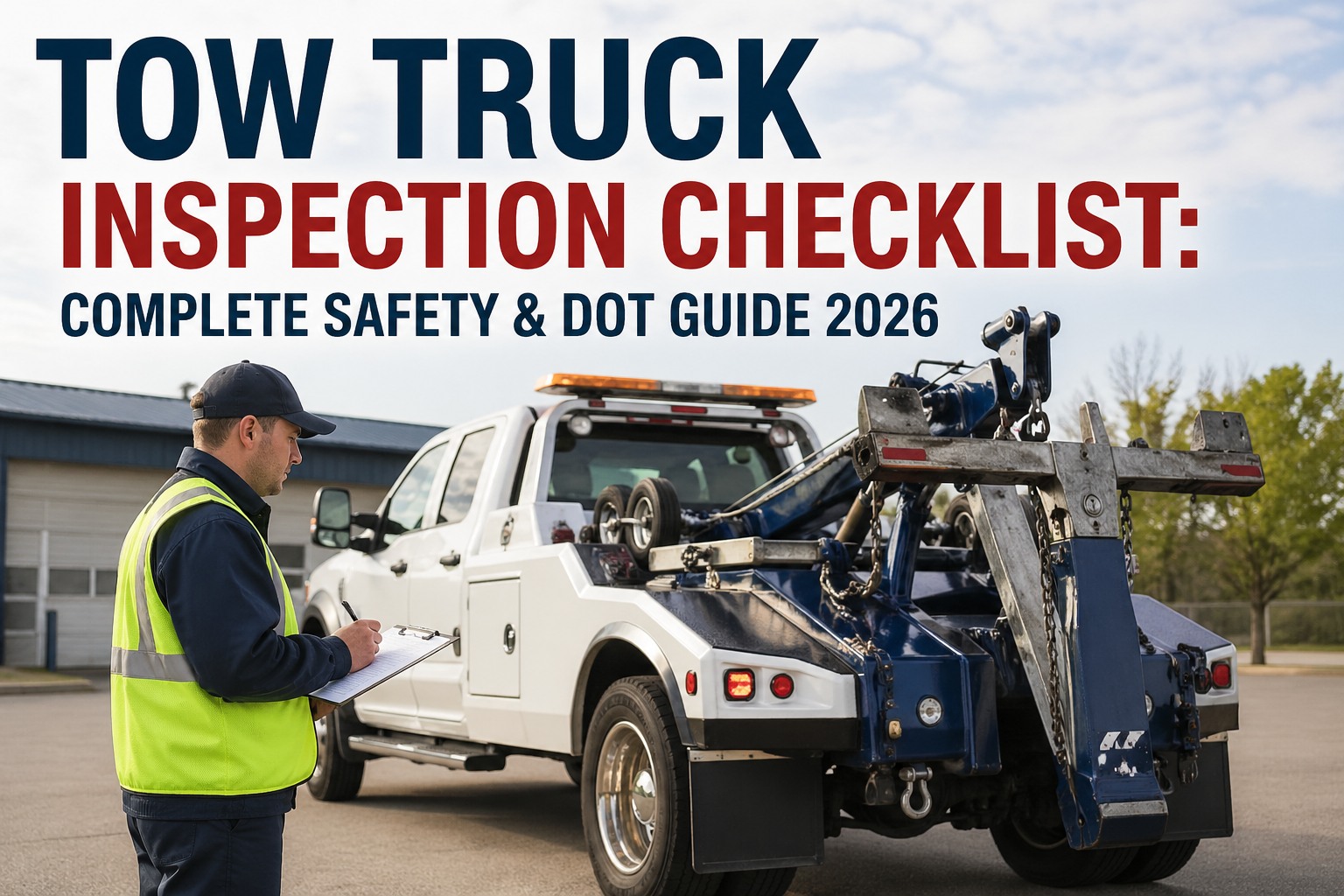
Tow Truck Inspection Checklist: Complete Safety & DOT Guide 2026
Boom, winch, underlift, hydraulics, lighting, safety chains, data plates — the complete daily and annual checklist for wreckers, roll-backs, and heavy-duty rotators. FMCSA-aligned, state-ready, audit-proof.
Why Daily Checks Matter
8,000+ lb
Force when a frayed winch cable snaps under load
$12K
Avg. DQ-file violation fine per driver in audit
OOS
A single brake adjustment violation = truck parked
15 min
Average pre-trip inspection time for trained operators
Quick Answer: What Is a Tow Truck Inspection?
DEFINITION
A tow truck inspection is a systematic check of every safety-critical system on a wrecker, roll-back, or heavy-duty recovery vehicle — covering the truck chassis, recovery equipment (boom, winch, underlift, wheel-lift, bed), hydraulics, lighting, tires, brakes, safety gear, and documentation. Inspections happen at three levels: daily pre-trip and post-trip (driver DVIR), periodic preventive maintenance (mileage- or time-based service), and annual DOT certification (state-level FMCSA-aligned audit). Tow trucks have additional specialized requirements beyond standard commercial vehicles — including data plates for boom/bed/wheel-lift capacity, grade-7 safety chains, oil absorbent kits, debris containers, and chock blocks.
The 6 Inspection Zones of a Tow Truck
A tow truck inspection moves through six distinct zones — each with its own failure modes, OOS triggers, and specialized equipment. Skipping any single zone exposes you to roadside violations, equipment failures, or worse. Contact our support team to map these zones to your fleet's DVIR workflow.
01
Chassis & Drivetrain
Engine bay, transmission, frame, suspension
Standard heavy-duty truck inspection — fluids, belts, hoses, leaks, frame integrity, mounting bolts. Tow trucks operate under heavier sustained loads than most CMVs, so frame stress and drivetrain wear are accelerated.
Frame cracksFluid leaksMount integrity
02
Lighting & Electrical
Front, side, rear, emergency, marker lamps
Per Utah DOT spec: headlamps, turn signals, four-way flashers, marker and ID lights, proper lamp color, mounting, and visibility. Tow-specific: rotating amber beacons, scene-lighting, work lights on boom and bed.
All lamps operableBeacons workingNo cracked lenses
03
Tires, Wheels & Brakes
Tire tread, inflation, brakes, slack adjusters
FMCSA's seven-step brake inspection — air compressor, brake chambers, slack adjusters, brake lines, parking brake. New 2026 OOS thresholds for brake adjustment and tire tread depth catch unprepared carriers.
4/32" steer tread2/32" other treadNo air leaks
04
Recovery Equipment
Boom, winch, cable, hooks, wheel-lift, bed
The tow-specific zone. Unspool winch cable completely for full inspection — kinks, frays, broken strands, corrosion. Check boom for cracks, hydraulic leaks, secured pivot pins. Inspect wheel-lift jaws, hooks, J-hooks, T-hooks.
Cable integrityHook latchesBoom welds
05
Hydraulics & Controls
PTO, valves, cylinders, hoses, controls
Hydraulic system powers every recovery operation. Check fluid levels, hose condition (no abrasion, swelling, weeping), cylinder seals, control responsiveness, emergency stop function. PTO engagement smooth and quiet.
No hose abrasionNo fluid weepE-stop works
06
Safety Gear & Documentation
Chains, blocks, signage, plates, paperwork
Grade-7 safety chains, chock blocks, oil absorbent kit, 5-gallon debris container, Class-2 safety vest, fire extinguisher, triangle reflectors. Data plates on boom/bed/wheel-lift stating maximum load capacity. Insurance, registration, DQ file.
Grade-7 chainsData platesClass-2 vest
Daily Pre-Trip Checklist (45 Critical Items)
Run this checklist every shift before the first call. Trained operators complete it in 12–15 minutes. Logging defects digitally auto-generates work orders so nothing falls through the cracks.
Cab & Chassis
✓Engine oil level — between min/max marks, no contamination
✓Coolant level — top of cold reservoir, no leaks
✓Hydraulic fluid — sight-glass check, no foaming
✓Steering play — within FMCSA limits for wheel size
✓Belts & hoses — no cracking, swelling, or chafing
✓Battery terminals — clean, tight, no corrosion
✓Wipers & mirrors — full sweep, mirrors aligned
✓Air pressure buildup — within FMCSA timing
Lighting & Electrical
✓Headlamps — both high and low beam
✓Turn signals — front, side, rear all working
✓Four-way flashers — proper timing, all lamps
✓Marker & ID lights — proper color, mounting, visibility
✓Brake & tail lamps — both bulbs, lens not cracked
✓Amber rotating beacons — full rotation, no flicker
✓Scene/work lights — boom and bed lights operate
✓Backup alarm — audible, proper decibel level
Tires, Wheels, Brakes
✓Steer tire tread — minimum 4/32"
✓Drive/trailer tread — minimum 2/32"
✓Tire pressure — match placard cold pressure
✓Wheel lugs — all present, properly torqued
✓Slack adjusters — within FMCSA stroke limits
✓Brake chambers — no leaks, secure mounting
✓Air lines — no abrasion, kinks, or weeping
✓Parking brake — holds at full stroke
Recovery Equipment
✓Winch cable — fully unspool, no kinks/frays
✓Cable end fittings — secure, no broken strands
✓Hooks & J/T-hooks — latches engage fully
✓Boom structure — no cracks, welds intact
✓Pivot pins & bushings — secured, lubricated
✓Wheel-lift jaws — open/close smoothly
✓Bed/deck condition — no warping, lock pins work
✓Tie-down chains/straps — rated for vehicle weight
Hydraulics & Safety
✓Hydraulic hoses — no abrasion or weeping
✓Cylinder seals — no fluid weep at rod
✓Control responsiveness — smooth, no hesitation
✓Emergency stop — verified working
✓Grade-7 safety chains — full set, no damaged links
✓Chock blocks — minimum 2 stiff legs/blocks
✓Oil absorbent kit — sufficient quantity onboard
✓5-gallon debris container — empty, accessible
Documentation
✓Boom data plate — visible, max load stated
✓Bed data plate — visible, max load stated
✓Wheel-lift data plate — visible, capacity stated
✓Registration & insurance — current, in cab
✓Medical certificate — driver, current
✓Class-2 safety vest — present, accessible
✓Fire extinguisher — charged, mounted
✓Triangle reflectors — full set of three
Stop Tracking Inspections on Paper
Run digital DVIRs from a phone. Defects auto-create work orders. Records stay audit-ready every day. See it working on your tow fleet.
Critical Out-of-Service (OOS) Triggers for Tow Trucks
A single OOS violation parks the truck immediately — towing fees, lost revenue, and CSA score damage all on the same day. These are the violations that most often sideline tow trucks at roadside inspections. Sign up free for 3 trucks to log every defect against the OOS criteria automatically.
!
Brake Adjustment
Brakes out of adjustment beyond FMCSA stroke limits or 20% of brakes inoperative = immediate OOS. Tow trucks running heavy loads see accelerated wear — check every shift.
!
Steering Defects
Excessive steering wheel play, leaking power steering, broken tie rods or drag links. The OOS threshold protects against catastrophic loss of control under load.
!
Tire Tread & Damage
Below 4/32" on steers, 2/32" on others, sidewall damage exposing belts, fabric showing. Updated 2026 standards specifically catch under-spec tow truck tires.
!
Coupling & Recovery Gear
Cracks in fifth wheel, loose/missing kingpin parts, frayed winch cable, broken hook latches, missing safety chains. Risk of separation = OOS, no exceptions.
!
Lighting Failures
Inoperative required lights — headlamps, turn signals, brake/tail, marker lamps. Tow trucks have additional state requirements for amber beacons and scene lighting.
!
Missing Data Plates
Boom, bed, or wheel-lift data plate missing or unreadable. Inspectors must verify maximum load capacity. Some states allow official documents in the cab as substitute.
Inspection Cadence: Daily / Monthly / Annual
Not every check happens every shift. Some are daily DVIR items, others run on monthly schedules, and DOT certification is annual. Here's how the work distributes across time intervals in a properly run tow operation.
Daily
By driver, every shift
Pre-trip DVIR (45 items)
Fluid levels
Lighting check
Tire pressure
Winch cable inspection
Safety gear present
Post-trip DVIR
Hydraulic system check
Hook & chain wear
Greasing pivot points
Battery terminals
Air dryer purge
Brake adjustment check
Suspension wear
Boom/bed bolt torque
Cable tension test
Cylinder seal inspection
Quarterly
Certified technician
Hydraulic fluid analysis
Boom NDT inspection
Wheel-lift load test
Alignment
Wheel bearing check
Annual
DOT-certified inspector
DOT annual inspection
State wrecker certification
Major component overhaul
Insurance audit
Driver DQ file review
Required Safety Equipment Inventory
Tow trucks carry specialized safety gear that standard trucks don't need — and inspectors verify each item. Missing equipment fails certification and can ground the vehicle until replaced. Talk to our support team to build an equipment audit into your inspection workflow.
Safety Chains (Min. Grade 7)
Lock towed vehicle to boom or bed; prevent breakaway
Inspect every link for damage, stretching, or wear
Oil Absorbent Kit
Absorb spilled diesel, antifreeze, battery acid from roadway
Sufficient quantity for accident scene cleanup
5-Gallon Debris Container
Contain glass and debris swept from roadway
Empty, accessible, in good condition
Chock Blocks / Stiff Legs
Stabilize the recovery vehicle on ice or slippery surfaces
Minimum two units, structurally sound
Class-2 Safety Vest
High-visibility for the operator at incident scenes
ANSI 107 compliant, clean, retroreflective intact
Fire Extinguisher (5 BC)
Engine bay or scene fires during recovery
Charged, current inspection tag, mounted
Triangle Reflectors (Set of 3)
Roadside warning device for disabled scene
Complete set, no broken or missing pieces
Data Plates (Boom / Bed / Wheel-Lift)
Display max load capacity for each lift component
Attached to component, OR official document in cab
Frequently Asked Questions
How often does a tow truck need DOT inspection?+
Tow trucks operating as commercial motor vehicles (CMVs) under FMCSA jurisdiction require an annual DOT inspection. Many states layer additional requirements — California's CHP wrecker program, Utah DOT certification, Texas TDLR inspection, Arizona DPS — each with their own equipment specifications. Drivers must also perform daily pre-trip and post-trip inspections (DVIRs) every shift. Sign up free to digitize daily DVIRs across your tow fleet.
What's the most common OOS violation for tow trucks?+
Brake adjustment violations top the list, followed by tire defects, lighting failures, and recovery equipment issues (frayed cables, missing chains, cracked hooks). Tow trucks see accelerated brake wear because of constant heavy loads, and winch cable damage often goes unnoticed without daily unspooling. The 2026 CVSA Out-of-Service Criteria added stricter brake stroke and tire tread thresholds that catch unprepared carriers.
Do I need separate data plates for boom, bed, and wheel-lift?+
Yes — each must display its maximum load capacity. Some vehicles consolidate into a single plate that lists capacities for all components, which most states accept. Per Utah DOT specs, an official document in the vehicle stating the same information also satisfies the requirement when individual plates aren't installed. Contact our support team for state-specific data plate guidance.
How long should winch cables last?+
Winch cable life depends on load patterns, environment, and inspection discipline. Typical life ranges from 12 months for heavily-used recovery cables to 36+ months for light-use cables. Replace immediately if you find: any broken strands within a one-foot section, kinks that won't straighten, severe corrosion, or visible flat spots from crushing. Daily unspool inspection catches problems before they become catastrophic failures.
Can a digital DVIR replace paper inspection forms?+
Yes — and it should. FMCSA accepts electronic DVIRs and roadside inspectors can review them via mobile app. Digital DVIRs auto-create work orders for every defect, build a permanent inspection history per truck, generate audit-ready reports in seconds, and prevent the "lost paperwork" gaps that cause DQ-file violations averaging $12,000 per driver in audits. Start your free trial to digitize tow truck inspections in minutes.
What documentation does an inspector check at roadside?+
At a Level 1 roadside inspection: driver's CDL, medical certificate, HOS logs (ELD), drug & alcohol Clearinghouse query confirmation, vehicle registration and insurance, annual DOT inspection sticker, DVIR records, plus tow-specific items — boom/bed/wheel-lift data plates, state wrecker certification (where applicable), and the safety equipment inventory described in your jurisdiction's tow rules.
Daily Inspections That Actually Get Done
Run Tow Truck Inspections in One Platform
Digital DVIRs from a phone, defects auto-create work orders, every record audit-ready. See how 500+ tow operators stay DOT-compliant, prevent breakdowns, and protect their CSA scores.
No credit card required. Free for up to 3 trucks. Tow-specific inspection templates included.