The single most asked question in fleet maintenance: "My truck just hit 50,000 miles — what services are due?" Or 100K. Or 250K. The answer matters more than most operators realize, because each odometer milestone unlocks a different set of wear thresholds, OEM-mandated services, and component lifespans. A truck running on a 5K-only oil-change rhythm but skipping the 50K transmission flush is no more "maintained" than a truck that gets nothing — both fail at the same place, just on different timelines. Mileage-based scheduling works only when you know exactly what's due at each milestone.
This guide turns the truck maintenance schedule into a milestone journey. From the 5,000-mile oil cycle through the 400,000-mile DPF service, every major mileage marker gets a dedicated breakdown — what's due, why it matters, what it costs, and what happens if you skip it. Severe-duty intervals (construction, stop-and-go, extreme climates) shorten these by 30–50%, so we've called those out at every milestone too. Modern fleet platforms layer telematics auto-sync on top of these intervals, so the truck tells the system when it's due — no driver self-reporting, no missed milestones.
Whether you're running a single owner-op rig or a 200-truck mixed fleet, the milestone framework below maps every service against real odometer numbers — exactly what you need at the moment you check the dash. Start your free trial to apply this milestone schedule to every truck automatically.
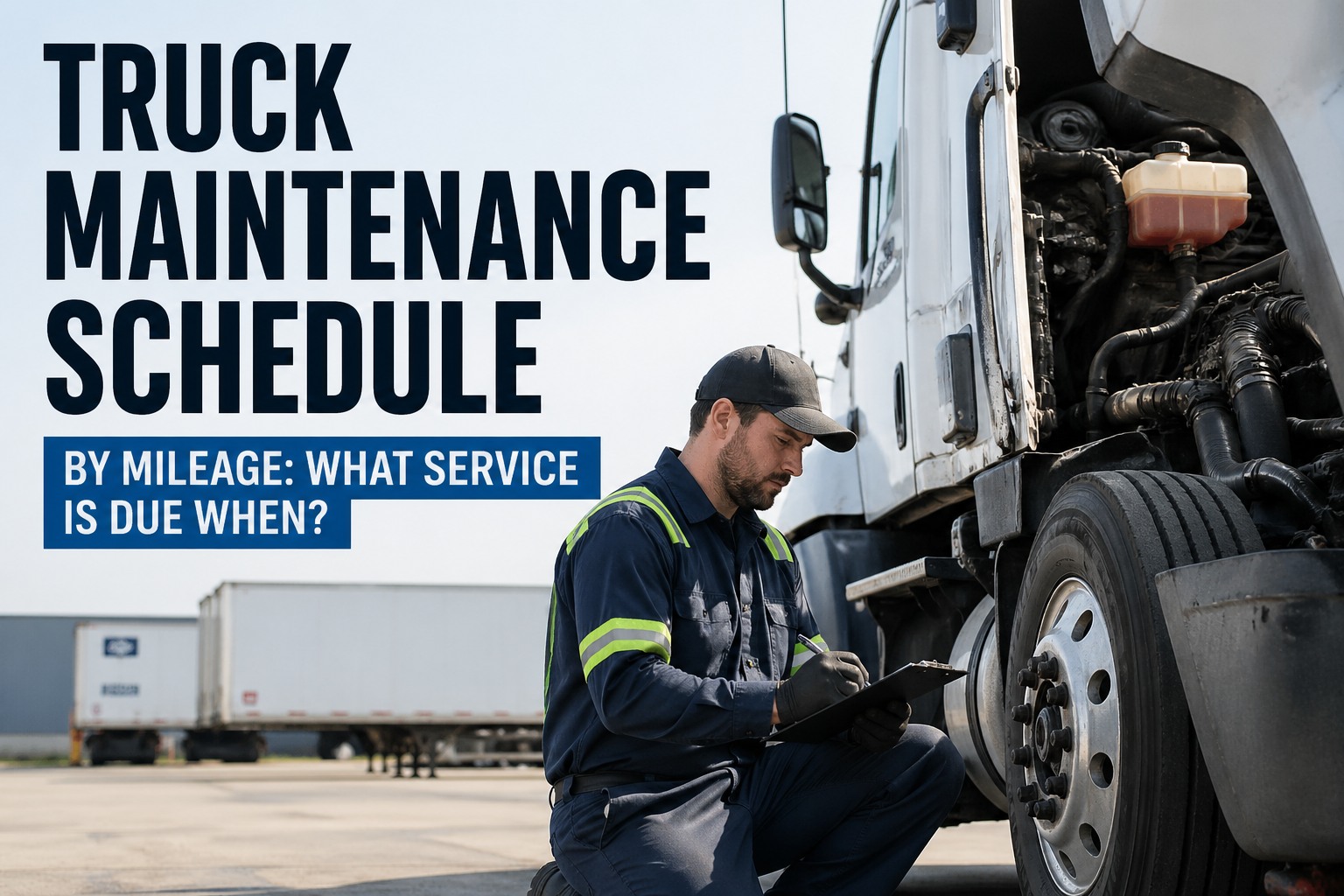
Truck Maintenance Schedule by Mileage: What Service Is Due When?
From 5,000 miles to 500,000+ — the complete milestone-by-milestone service guide for diesel trucks, with normal & severe-duty intervals, costs, and what happens if you skip the service.
Quick Answer: How Mileage-Based Maintenance Works
A truck maintenance schedule by mileage is a service plan where each component or fluid is replaced or inspected at a specific odometer milestone — not on a calendar timer or after a failure. The standard diesel truck schedule covers 8 major milestones: 5,000 mi (oil & tire rotation), 15,000–25,000 mi (engine oil for synthetic, fuel filter), 30,000 mi (air filter, brake inspection), 50,000–60,000 mi (transmission, coolant, brake pads), 100,000 mi (spark check, suspension), 150,000 mi (valve adjustment, power steering), 250,000–300,000 mi (differential, fan belt), and 400,000+ mi (DPF clean, major rebuild markers). Severe-duty operations (construction, stop-and-go, extreme heat or cold) compress these intervals by 30–50%. Modern fleet platforms auto-sync the odometer via telematics, so each truck triggers its own service alerts based on actual miles driven — eliminating missed milestones entirely.
The 8 Mileage Milestones at a Glance
Here's the full odometer roadmap. Each milestone is a service "checkpoint" — a moment where specific wear thresholds get hit and specific components need attention. The 30-60-90 rhythm familiar from passenger cars scales up to a 5K through 400K+ rhythm for diesel trucks. Contact our support team to map these milestones against your specific OEM and duty cycle.
Milestone 1 · Every 5,000 Miles: The Foundation
The 5,000-mile checkpoint is the heartbeat of your maintenance program. Skip it and every other milestone compounds the damage. This is where conventional oil gets changed, tires get rotated, and the truck gets a quick health snapshot.
Milestone 2 · Every 15,000–25,000 Miles: Synthetic Oil & Fuel Filter
Fleets running synthetic oil extend the oil interval to 15,000–25,000 miles. This is also the standard PM-A interval — the first "real" preventive maintenance touchpoint that includes a fuel filter on diesel trucks.
Milestone 3 · Every 30,000 Miles: Filters & Brake Inspection
At 30K, the air filter gets attention along with the first measured brake inspection. The cabin air filter is also due if your truck has one. This is when small wear items start showing up if previous milestones were skipped.
Milestone 4 · Every 50,000–60,000 Miles: Transmission & Major Components
The 50K mark is the most-skipped milestone in the entire schedule — and the most expensive to skip. Brake pads typically need replacement, transmission fluid breaks down, and coolant chemistry starts losing its protective properties. Sign up free for 3 trucks to lock in 50K alerts before they become $8,000 surprise repairs.
Milestone 5 · Every 100,000 Miles: The Major Service
The 100K milestone separates well-maintained trucks from neglected ones — visibly. This is when systems that have run continuously for 100,000 miles need their first comprehensive inspection. The 100K service is essentially a complete head-to-toe checkup.
Milestone 6 · Every 150,000 Miles: Valve Adjustment & Steering
The 150K milestone introduces the first valve adjustment — a critical procedure that affects engine performance, fuel economy, and emissions compliance. Air dryer filter and power steering fluid also become priorities here.
Milestone 7 · Every 250,000–300,000 Miles: Differential & Drivetrain
The high-mileage range — 250K and beyond — is where component replacements (not just inspections) become standard. Differential oil replacement is mandatory at 250K for normal duty. Fan belt replacement and the second valve adjustment fall in this window too.
Milestone 8 · 400,000+ Miles: DPF & Major Overhaul Markers
The high-life milestone. DPF (diesel particulate filter) cleaning or replacement, deep emissions service, and the planning conversation about replace-vs-rebuild. Trucks that hit 400K with a clean PM record routinely run past 1 million miles. Trucks without records are usually retired here.
Normal Duty vs Severe Duty: How to Tell the Difference
Severe-duty operation cuts every milestone by 30–50%. The question is: does YOUR fleet qualify as severe duty? Most fleets underestimate their severity classification — and pay for it through accelerated wear and missed services. Talk to our support team to classify each truck in your fleet against severe-duty triggers.
Frequently Asked Questions
For conventional oil: every 5,000 miles. For synthetic oil (the modern fleet standard): every 15,000–25,000 miles, depending on OEM specification. Severe-duty operation cuts this to 10,000 miles for synthetic and 3,000 miles for conventional. The single best determinant is your engine OEM's recommendation crossed with oil analysis results — many fleets extend intervals safely once oil analysis confirms the additive package is still active. Sign up free to track oil intervals across every truck.
The 50,000-mile service. It's the most commonly skipped milestone (because nothing visibly fails between 5K oil changes), and it's also the most expensive to skip. Transmission fluid breakdown, brake pad replacement, coolant chemistry exhaustion, and wheel bearing wear all hit at 50K — a missed 50K service routinely turns into an $8,000 transmission failure or a $5,000 brake-and-rotor emergency repair within the next 25,000 miles.
Severe duty compresses every interval by 30–50%. So a 50K transmission service becomes 30K, a 150K valve adjustment becomes 100K, and a 400K DPF service becomes 250K. Severe duty applies to construction, oilfield, mining, stop-and-go urban delivery, extreme climate operation, frequent heavy loads, and heavy idle/PTO use. Contact our support team for help classifying each truck against severe-duty triggers.
OEM intervals are conservative starting points designed for average operating conditions. Most fleets running OTR highway routes can safely follow OEM intervals exactly. Severe-duty fleets must shorten — typically 30–50% as noted at each milestone. The smart move is to run OEM intervals for the first 100K miles while building oil-analysis baselines, then optimize intervals based on real fleet data and operating conditions.
Modern fleet platforms auto-sync the odometer via telematics — every truck reports actual miles driven continuously, and the system fires alerts 500–1,000 miles before each upcoming milestone. This eliminates manual tracking, missed services, and "phantom" mileage discrepancies between dispatch records and shop records. Manual tracking via spreadsheets typically misses 15–25% of milestones. Start your free trial to auto-track every milestone.
Run the equivalent of a "catch-up service" — perform every service that would have been due at the closest previous milestone, even if it might have been done. Cost is typically $2,000–$4,000 but resets your maintenance baseline. Send oil samples for analysis to assess engine condition. Pull fault code history from the ECM. From that point forward, run the milestone schedule from the truck's current odometer with severe-duty intervals (since you don't know its prior duty cycle).
Auto-Track the Mileage Milestone Schedule
Telematics syncs odometers continuously. Service alerts fire 500 miles before each milestone. Work orders auto-create with the right service items pre-loaded. See how 500+ fleets hit 95%+ PM compliance using mileage-triggered scheduling.