A fleet manager's job in 2026 looks nothing like it did five years ago. The Federal Motor Carrier Safety Administration's new Safety Measurement System now splits Vehicle Maintenance into two separate compliance categories — meaning a fleet with poor maintenance records shows up red twice instead of once. MC numbers were eliminated entirely on October 1, 2025. Paper medical certificates expire as a verification method on January 10, 2026. And every single one of these regulatory shifts lands on the maintenance manager's desk, alongside the daily reality of $760-per-day downtime costs, $16,000 violation fines, and a workforce that expects mobile-first tools instead of clipboards.
This handbook covers every dimension of maintenance for trucks that fleet managers must master in 2026 — daily inspections, PM scheduling, work order management, parts inventory, technician productivity, DOT compliance, and the KPIs that prove the program is working. It's structured around five operational pillars, with the specific 2026 regulatory changes integrated into each section, and the digital workflows that turn paper-era headaches into 30-second processes. Fleets that master all five pillars run 95%+ uptime, audit-ready every day, with $15K–$25K per truck in annual savings versus reactive operations.
This is the fleet manager's reference for everything maintenance — the framework, the regulations, the metrics, and the tools that turn maintenance from a cost center into a competitive advantage. Start your free trial to run all five pillars on one platform.
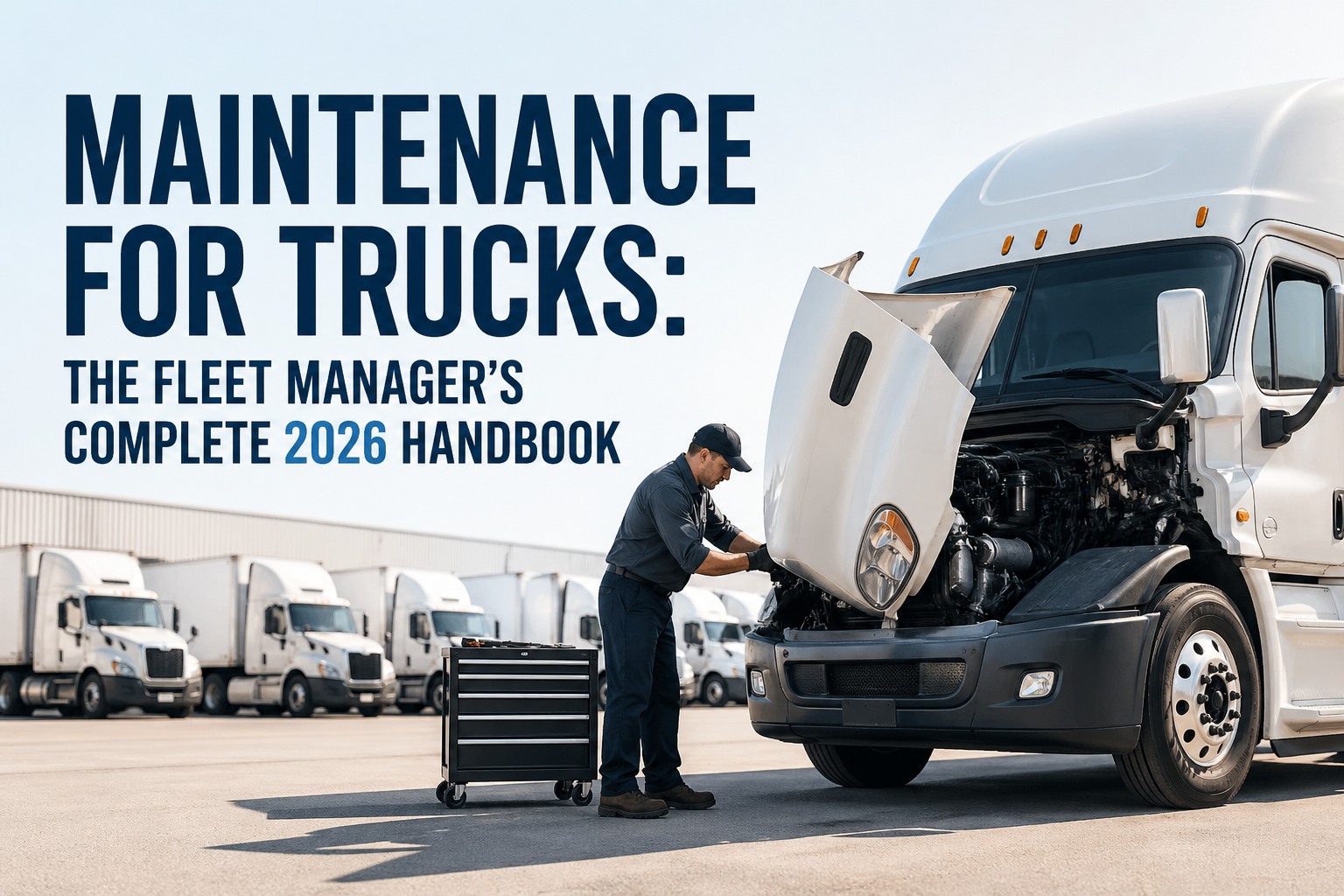
Maintenance for Trucks: The Fleet Manager's Complete 2026 Handbook
Five pillars. One handbook. The complete reference for every dimension of fleet maintenance in 2026 — from daily DVIRs through DOT audits, with the regulatory changes and digital workflows fleet managers actually need.
Quick Answer: What Is Fleet Maintenance Management?
Fleet maintenance management is the integrated system fleet managers use to keep commercial trucks operational, compliant, and cost-effective across their service life. It encompasses five interconnected pillars: daily driver inspections (DVIRs), scheduled preventive maintenance (PM), corrective work orders, parts and inventory management, and FMCSA/DOT compliance documentation. Modern fleet maintenance runs on a digital platform that connects all five pillars — when a driver flags a defect during DVIR, the system auto-creates a work order, reserves the right parts, alerts the technician, tracks the repair, and stores the audit-ready compliance record. The 2026 best-practice framework treats maintenance not as an expense to minimize, but as the highest-ROI activity in fleet operations — saving $4–$8 per dollar invested.
The 5 Pillars of Fleet Maintenance
Every successful fleet maintenance program rests on these five operational pillars. Each pillar has its own owners, tools, regulations, and KPIs — but the real ROI comes from connecting them so data flows continuously between them. Contact our support team to map your current maintenance operations against this 5-pillar framework.
Pillar 1: Daily Inspection (DVIR) Workflow
DVIRs are the foundation. Federal regulation 49 CFR §396.11 requires every driver to report defects affecting safety after every shift, and the carrier must certify repairs before the vehicle returns to service. The break in this chain is one of the most-cited compliance findings in 2026 audits.
Pillar 2: PM Schedule Quick-Reference
Every fleet manager should keep these intervals memorized. They form the baseline structure that every duty cycle and OEM spec gets adjusted against. Sign up free for 3 trucks to apply these intervals across your entire fleet automatically.
| Service | Standard Interval | Severe Duty | Tier | Critical? |
|---|---|---|---|---|
| Engine oil & filter | 15,000–25,000 mi | 10,000 mi | PM-A | Yes |
| Tire rotation & balance | 10,000–15,000 mi | 5,000 mi | PM-A | Yes |
| Fuel filter | 25,000–45,000 mi | 15,000 mi | PM-B | Yes |
| Air filter | 30,000 mi | 15,000 mi | PM-B | Med |
| Brake inspection | 25,000 mi / quarterly | 10,000 mi | PM-B | Yes |
| Transmission fluid | 50,000–60,000 mi | 30,000 mi | PM-C | Yes |
| Coolant flush | 30,000–50,000 mi | 25,000 mi | PM-C | Med |
| Differential service | 50,000 mi | 30,000 mi | PM-C | Med |
| DOT annual inspection | Annually | Annually | PM-C/D | Yes |
| Engine overhaul check | 500,000+ mi | 350,000 mi | PM-D | Yes |
Pillar 3: Anatomy of a Modern Work Order
A work order is the operational record of every repair. Done right, it's the document that protects warranty claims, defends DOT audits, and gives finance the cost-per-mile data they need. Every work order should capture these 8 elements.
Pillar 4: Parts & Inventory Management
Strategic parts management saves 20–30% on annual parts spend. The fleets winning at this don't just stockpile parts — they balance fast-moving consumables, slow-moving specialty items, vendor relationships, and warranty tracking into a system that keeps techs working without dead inventory tying up cash.
Pillar 5: 2026 DOT Compliance Cheat Sheet
The regulatory ground shifted significantly in 2026. Here are the changes every fleet manager needs to know about right now — and the record retention rules that haven't changed but still get most fleets cited. Talk to our support team for a compliance audit against these 2026 changes.
The KPIs That Prove Your Program Works
You can't improve what you can't measure. These six KPIs are the dashboard every fleet manager should review weekly — they reveal whether the 5-pillar system is actually working, or whether maintenance is quietly bleeding budget through the gaps.
Frequently Asked Questions
Five operational pillars: daily driver DVIR inspections, scheduled preventive maintenance (PM-A through PM-D tiers), corrective work orders generated from defects/fault codes, parts and inventory management, and DOT/FMCSA compliance documentation. The 2026 best-practice approach unifies all five into one digital platform so data flows continuously between them — DVIR defects auto-create work orders, PM thresholds trigger services, parts auto-reserve when WOs open, and every record stores audit-ready under §396 retention rules. Sign up free to run all five pillars on one platform.
Reactive fleets spend $22,000–$25,000 per Class 8 truck annually. Fleets running structured PM programs spend $12,000–$15,000 — a 40% reduction. The savings come from avoided emergency repairs (3–5× cost premium), avoided downtime ($760/day), extended vehicle life (20% longer), and 5–10% fuel economy gains. Cost-per-mile benchmarks: top quartile $0.42, industry average $0.65–$0.85, reactive fleets $1.20+.
Four major regulatory shifts: MC numbers eliminated October 2025 (USDOT only now), paper Medical Examiner Certificate verification ended January 10, 2026 (MVR-only for CDL drivers), SMS scoring split Vehicle Maintenance into two compliance categories (penalty exposure doubled), and recent six-month violations now carry heavier weight in CSA scores. Contact our support team for a 2026 compliance audit against these specific changes.
The top maintenance citations: incomplete DVIR certification chains (gaps between driver report → mechanic repair → driver verification), missing or expired DOT annual inspection records, missed PM intervals on safety-critical components (brakes, steering, tires), missing Driver Qualification file annual reviews, and Drug & Alcohol Clearinghouse query gaps. Most cite for under $5,000 individually but compound fast — fleets routinely face $30,000+ in cumulative findings during compliance reviews.
The hybrid model wins for most fleets. Keep high-frequency, low-complexity work in-house — PM-A oil services, DVIR-triggered minor repairs, basic diagnostics. Outsource specialty work to vendors — engine rebuilds, transmission overhauls, alignments, body work. Smaller fleets without shop facilities outsource everything to a partner shop. The platform ties both flows together — vendor work orders, costs, and warranty data stored against the same asset record as in-house repairs. Sign up free to track in-house and vendor work in one system.
One unified platform covering all five pillars: digital DVIR (mobile app for drivers), PM scheduling (multi-trigger by mileage/hours/calendar), work order management (auto-generated from DVIR/PM/fault codes), parts and vendor management, and DOT compliance documentation (audit-ready retention). Avoid stacking 4–5 separate tools — the integration gaps between them are exactly where defects get lost and audit trails break. Modern platforms integrate with 200+ telematics providers, so existing GPS hardware feeds in without replacement.
Run All 5 Pillars in One System
DVIR, PM scheduling, work orders, parts management, and DOT compliance — connected end-to-end. See how 500+ fleets cut maintenance costs 30%, hit 95%+ uptime, and stay audit-ready every day.