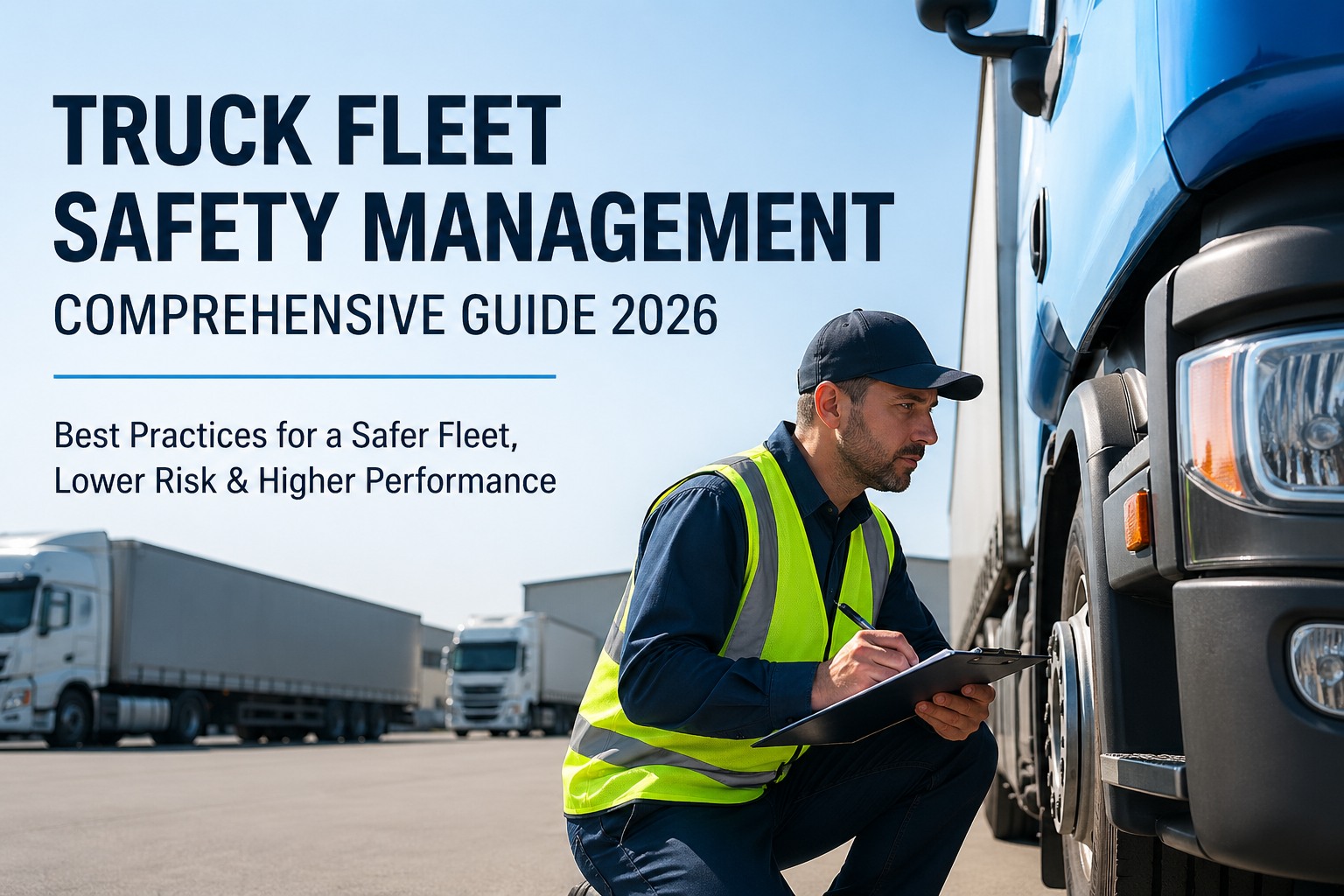
Every fleet manager knows the call they fear most — the one that says a driver is on the side of the highway, an accident has happened, and lives may be at stake. The numbers behind that fear are sobering: large trucks were involved in 5,930 fatal crashes in 2022, a 49% increase since 2013, and in 2025 over 190,000 CDL drivers held "prohibited status" representing 3-4% of the entire workforce. With FMCSA tightening enforcement in 2026 — new Clearinghouse rules, ELP enforcement, and modernized Safety Measurement System scoring — fleet safety is no longer just compliance. It's survival. This guide breaks down the five pillars that keep fleets safe, compliant, and profitable in 2026. Talk to our team to assess your fleet's current safety posture.
The 5 Pillars of Fleet Safety Management
Safety isn't a single checklist — it's a layered defense system. Each pillar covers a different threat vector, and the strongest fleets reinforce all five simultaneously. A weakness in any one pillar creates the gap where accidents, violations, and downtime happen. Here's how the layers stack:
Vehicle Inspection & Maintenance
Daily DVIRs, tiered PM schedules, and audit-ready repair documentation. The mechanical foundation of every safe fleet. Skip this and the rest collapses.
Driver Qualification & Training
DQ files, MVR pulls, ELDT-compliant training, ongoing skill development. Your drivers are your single biggest safety asset — and your single biggest liability.
Compliance & Documentation
HOS logs, ELD compliance, Clearinghouse queries, EPA records, CARB requirements. The paperwork war that determines whether you pass an audit or get shut down.
Risk Mitigation & Monitoring
Telematics, dash cams, real-time driver behavior tracking, fatigue management. The early-warning system that catches problems before they become headlines.
Safety Culture & Reporting
Incident reporting, near-miss tracking, leadership accountability, driver coaching cycles. The intangible layer that turns rules into reflexes.
2026 Regulatory Changes — What Just Got Tougher
FMCSA isn't standing still. The 2026 enforcement landscape has shifted toward data-driven oversight with stricter penalties for repeat offenders. Fleets running on legacy systems are sitting ducks. Here's what changed and what your safety program now must handle:
Clearinghouse Status Downgrades
States now downgrade CDL privileges for drivers in "prohibited" Clearinghouse status. Over 190,000 CDL drivers currently affected. Pre-employment and annual queries are non-negotiable.
Non-Compliant ELDs Out of Service
Drivers using non-compliant electronic logging devices may be placed out of service immediately. ELD hardware/software upgrades required across the industry.
SMS Modernization
Safety Measurement System consolidates violation codes, weights recent 12 months heavier, and refines peer group comparisons. Old strategies for managing CSA scores no longer work.
Medical Certification Integration
NRII rule lets medical examiners transmit results electronically to National Registry. Paper certificates valid only 60 days post-issuance from April-October 2026.
HOS Flexibility Programs
FMCSA pilots allow pausing the 14-hour driving window up to 3 hours. 500+ drivers participating. May reshape how fleets manage duty periods long-term.
Automatic Emergency Braking
Class 7-8 trucks proposed compliance by 2027, Class 3-6 by 2028. Forward-thinking fleets are equipping new trucks now to avoid the 2027 retrofit rush.
The Safety KPI Dashboard
You can't manage what you don't measure. Best-in-class fleets track these six metrics weekly, not annually. Each one is a leading indicator that catches problems before they become incidents:
% of scheduled PMs completed within 10% of due date. Below 90% guarantees future breakdowns. The single highest-leverage safety metric.
Defects per inspection. Spikes signal training gaps or fleet-wide issues. Track trend lines, not just absolute numbers.
Industry best-in-class. Above 1.0 per million miles is a CSA red flag. Direct correlation with insurance premium increases.
% of duty periods with violations. ELD data should drive this near zero. Anything above 5% triggers FMCSA review.
% of driver qualification files complete and current. Missing documents are #1 cause of audit failures and out-of-service orders.
Days between defect identification and repair completion. Long lag times = unsafe trucks operating between PM cycles.
Track every safety KPI in one dashboard
Truck Inspection & Maintenance pulls DVIR data, PM compliance, HOS records, and DQ file status into one screen. Real-time alerts when any metric drops below threshold. 10-minute setup. No credit card required.
The Crash Prevention Funnel
Every preventable crash passes through five warning stages before impact. Strong safety programs catch the warnings early — weak ones discover them only after the wreck. Here's the funnel from signal to incident:
Behavioral Indicators
Hard braking events, speeding incidents, harsh cornering. Telematics catches these in real time. Action: Coach immediately.
Pattern Formation
Same driver, same behaviors, multiple times per week. Risk score elevates. Action: Formal training intervention.
Near-Miss Events
Sudden swerve, lane departure caught by system, panic-stop incidents. Action: Investigation + coaching + monitoring.
Minor Incidents
Property damage, low-speed collisions, parking lot scrapes. Action: Root-cause analysis + leadership review.
Major Crash
Injury, fatality, or significant damage. Action: Far too late — the cost is already paid in dollars, lives, and reputation.
Industry data: Fleets that intervene at Signals 1-2 reduce major crashes by up to 70%. Fleets that wait until Signal 4 see compounding insurance costs and FMCSA penalties.
Safety Program Maturity Levels
Where does your fleet sit on the safety spectrum? Each level represents a fundamentally different operating posture — and a fundamentally different cost structure. Sign up free to benchmark your fleet against these tiers in under 10 minutes:
Paper logs, manual DVIRs, "we'll deal with it when it happens." Compliance only after violations. CSA scores in the red.
Basic ELDs, scheduled PMs, DQ files current. Meeting minimums but not optimizing. Average insurance rates, occasional violations.
Telematics-driven coaching, KPI dashboards, structured training cycles. CSA scores trending green. Insurance discounts available.
Predictive analytics, near-miss culture, leadership-driven safety reviews. 70%+ crash reduction. Premium insurance tiers, top-tier driver retention.
Real Cost of Poor Safety
Beyond the obvious tragedy of a major incident, weak safety management compounds across multiple cost categories. Here's what flows through a fleet when safety lapses:
Compounds quickly across multi-violation roadside inspections
Per truck, including missed deliveries and crew costs
After preventable crash with high CSA scores
Per driver lost due to unsafe equipment or culture
Settlements, legal, vehicle replacement, reputation damage
Without documented safety and maintenance history
Building Your Safety Roadmap — 90 Days to Transformation
You don't fix safety in a day. But 90 days is enough to move from reactive chaos to proactive control. Here's the implementation timeline that works:
Audit & Baseline
Inventory every truck, every driver file, every PM record. Calculate current CSA scores, PM compliance, DVIR defect rate. Identify the worst-performing 20% — that's where your gains are.
Digitize & Standardize
Move DVIRs, PM scheduling, and DQ files into a unified digital system. Eliminate paper. Build automated alerts for upcoming PMs, expiring medical certificates, and overdue defects.
Train & Equip
Driver coaching cycles begin. Telematics dashboards launch. Supervisors trained on near-miss reporting protocols. Establish weekly safety stand-ups with KPI review.
Measure & Refine
Compare baseline vs current. PM compliance should hit 90%+. DVIR defect resolution under 30 days. CSA score trends visible. Refine intervals, training, and reporting based on data.
Frequently Asked Questions
What are the core elements of a fleet safety management program?
Five pillars: vehicle inspection & maintenance (49 CFR 396), driver qualification & training (49 CFR 391), compliance & documentation (HOS, ELD, Clearinghouse), risk mitigation & monitoring (telematics, dash cams), and safety culture & reporting (near-miss tracking, coaching). Weakness in any one creates the gap where incidents happen. Contact our support team to assess your fleet across all five.
What changed in 2026 FMCSA regulations?
Major shifts include automatic CDL downgrades for drivers in Clearinghouse "prohibited" status (190,000+ drivers affected), out-of-service orders for non-compliant ELDs starting January 20, 2026, modernized SMS scoring that weights recent 12 months heavier, and the NRII rule digitizing medical certification. Fleets running legacy compliance systems face significantly higher enforcement risk in 2026.
How much does a structured safety program reduce crashes?
Industry data shows up to 70% reduction in preventable crashes for fleets that move from reactive to proactive safety management. Best-in-class operations track preventable crashes per million miles below 0.5 — well under the FMCSA red-flag threshold. The same fleets typically see 15-40% reductions in insurance premiums within 18 months.
Which safety KPIs matter most?
Six leading indicators: PM compliance rate (target 95%+), DVIR defect rate (under 5%), preventable crashes per million miles (under 0.5), HOS violation rate (under 2%), DQ file currency (100%), and defect resolution time (under 30 days). These catch problems before they become incidents. Sign up free to track all six in real time.
What's the realistic timeline to fix a weak safety program?
90 days is enough to move from reactive to proactive. Days 1-15: audit and baseline. Days 16-30: digitize DVIRs, PMs, DQ files. Days 31-60: train drivers, launch telematics. Days 61-90: measure and refine. Most fleets see measurable CSA score improvements within 60 days and full transformation within 6 months.
How does inspection and maintenance software improve fleet safety?
Truck Inspection & Maintenance ties daily DVIRs to maintenance work orders, PM scheduling to compliance records, and defect findings to repair documentation — creating a closed loop that satisfies FMCSA 49 CFR Part 396 audit requirements. Drivers complete inspections on mobile, defects auto-route to maintenance, and audit-ready records are surfaced instantly. Contact our specialists to see it on your fleet data.
Your safety program shouldn't depend on luck.
Truck Inspection & Maintenance unifies DVIRs, PM scheduling, defect tracking, and audit-ready compliance into one platform. Drivers complete inspections on mobile in 5 minutes. Maintenance auto-prioritizes safety-critical defects. DOT-compliant audit trail built in. Free for up to 3 vehicles.