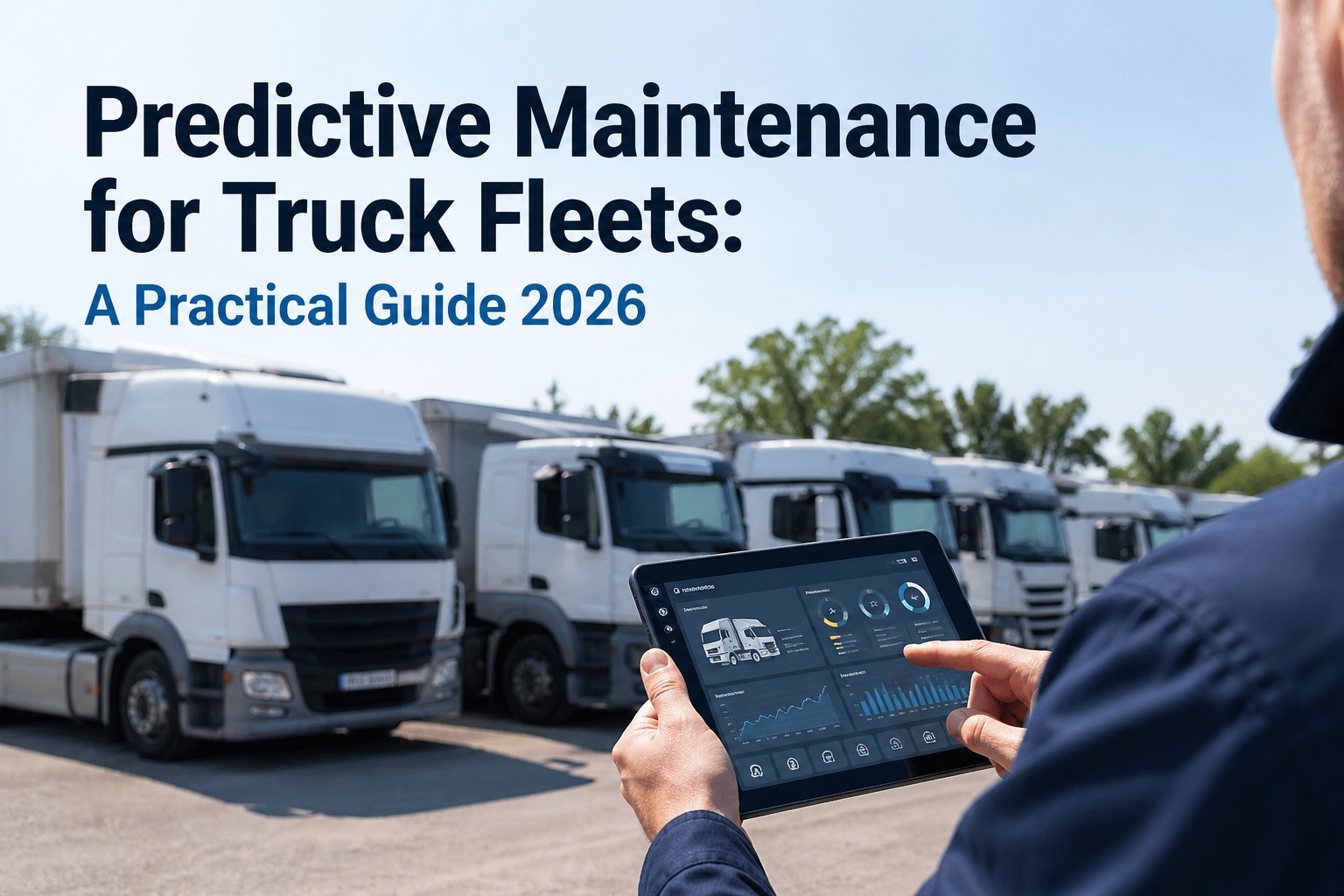
Your trucks are already telling you when they'll break down. The problem is, no human can listen. A single Class 8 truck generates 25,000+ data points per day across engine sensors, telematics, and diagnostics. Hidden in that signal stream are early warning patterns — engine temp running 12°F hotter than baseline, oil pressure drifting, vibration signatures changing — that precede failures by 2 to 4 weeks. AI predictive maintenance is the layer that finds those patterns automatically. Deloitte data confirms predictive systems reduce breakdowns by 70%, cut maintenance costs by 25%, and increase productivity by 25%, yet 73% of fleets still run reactive maintenance that costs 3-5x more. This guide breaks down exactly how predictive maintenance works, what sensors matter, and how to deploy it in 2026. Talk to our team to map a predictive strategy for your fleet.
The Predictive Maintenance Pipeline — How Data Becomes Decisions
Predictive maintenance isn't a single sensor or a single algorithm. It's a five-stage pipeline that converts raw vehicle signals into actionable work orders. Each stage adds intelligence to the data flowing through. Here's the architecture in action:
Data Capture
IoT sensors + OBD-II/J1939 ports stream engine, brake, tire, battery, and vibration data in real time. 25,000+ data points per truck daily.
Cloud Storage
Edge processing filters noise, then streams clean data to cloud infrastructure. Petabyte-scale storage built specifically for time-series sensor data.
AI Pattern Detection
Machine learning models compare live data against fleet-wide failure signatures. Detects anomalies invisible to human technicians or fault codes.
Failure Prediction
Each truck gets a real-time 0-100 health score updated every 15 minutes. AI calculates probability of specific component failure in the next 30 days.
Work Order Action
When risk crosses threshold, system auto-generates prioritized work orders with right parts, technician, and planned downtime window. No emergency required.
The 6 Sensor Types That Catch 90%+ of Failures
Not all sensors deliver equal predictive value. These six categories account for over 90% of detectable commercial fleet failure events. Each has a different lead time and ROI profile:
Oil pressure, coolant temp, fuel rail pressure, misfire patterns, EGR valve performance. The richest single source of predictive data — most trucks already have it.
Detects bearing wear, alignment issues, and rotating component failures. Highest single-failure-mode prediction accuracy of any sensor type. $300-800 per measurement point.
TPMS catches slow leaks, blowout risk, and uneven wear before drivers notice. Critical for fuel economy — improperly inflated tires cost 3% MPG.
Voltage drift, alternator output, charge cycle anomalies. Catches battery and alternator failures before they strand drivers — the #1 cause of avoidable roadside calls.
Pad thickness sensors + brake temperature data. Predicts pad replacement timing and detects unusual heat patterns that signal caliper or rotor issues.
Backpressure, soot accumulation, regen frequency. Catches DPF failures early — the difference between a $1,200 cleaning and an $8,000 replacement.
Reactive vs Preventive vs Predictive — The Three Maintenance Models
Understanding what predictive maintenance is requires understanding what it isn't. Each model uses fundamentally different triggers and produces fundamentally different cost outcomes:
Reactive
Preventive
Predictive
Hybrid wins: 66% of leading fleets in 2026 use a combination — preventive for routine items, predictive for high-value and failure-critical components. Sign up free to see how the hybrid approach maps to your fleet.
What Predictive Maintenance Catches That Schedules Miss
Calendar-based PM is great for known wear patterns. It can't catch the failure that develops between two scheduled services. Here are the seven signature failure types where AI consistently beats fixed schedules:
Bearing wear (rotating parts)
Vibration signatures appear 10-30 days before failure. Calendar PM rarely catches early bearings.
Cooling system stress
Coolant temp drift catches radiator/water-pump issues before overheat events.
DPF clogging trends
Backpressure trending upward signals impending regen failure or DPF replacement need.
Alternator/battery decay
Voltage drift over weeks catches the slow death of charging systems.
Injector degradation
AI correlates fuel burn, exhaust temp, and torque to identify a single failing injector.
Turbo failure signatures
Boost pressure anomalies and oil contamination patterns precede turbo failure 3-4 weeks out.
Brake pad anomalies
Uneven wear patterns flag caliper sticking — caught months before annual brake job.
Activate predictive maintenance on your fleet
Truck Inspection & Maintenance ingests your existing telematics and OBD data, builds vehicle baselines within 24 hours, and starts surfacing failure predictions within 72 hours. No new hardware. No replacement of your current systems. Free for up to 3 vehicles.
The ROI Math — What Predictive Delivers
The financial case isn't theoretical. Documented industry outcomes show consistent results across fleet sizes and types. Here's what the numbers look like:
4-Phase Deployment Roadmap
Successful predictive maintenance deployments treat it as a workflow program with technology support — not a technology project alone. Here's the phased approach that works in 2026:
Identify the Critical 20%
Audit historical breakdown costs. Rank assets by failure impact. Focus predictive investment on the 20% of trucks that drive 80% of breakdown cost. Skip the broad-deployment temptation that sinks most pilots.
Connect Data Sources
OBD-II/J1939 dongles or telematics integration. Most fleets already have 60-70% of needed data — they just aren't using it. Vibration sensors added on highest-cost rotating equipment. 14-day baseline data collection.
Train AI Models & Workflows
ML models train on your specific fleet's patterns. Alert workflow design — who responds, how fast, what action. Technician feedback loop tunes false-positive thresholds. First reliable predictions go live.
Scale & Refine
Roll out to remaining fleet. Predictions improve with more data. ROI becomes measurable — typical fleets show 2-4x return by month 12. Continuous tuning based on actual breakdown vs predicted breakdown delta.
Common Pitfalls — And How to Avoid Them
Most predictive maintenance pilots fail not because the technology doesn't work, but because the operational workflow doesn't. These are the four most common failure modes — and the fixes:
Alert fatigue from false positives
Fix: Tune thresholds in first 60 days. Treat false positives as model-tuning data, not system failure. Most platforms get to under 5% false positive rate within 3 months.
Sensors without workflow
Fix: Define the alert-to-action chain before going live. Who owns each prediction? What's the response SLA? Predictions without owners get ignored.
Broad deployment too fast
Fix: Start with the Critical 20% of assets. Prove value, build process, then scale. Fleet-wide pilots without traction kill more programs than bad sensors do.
No CMMS integration
Fix: Predictions must auto-create work orders in your maintenance system. Email alerts that require manual scheduling die in the inbox. Closed-loop integration is non-negotiable.
Frequently Asked Questions
What is predictive maintenance for truck fleets?
Predictive maintenance uses IoT sensors, telematics data, and machine learning to forecast component failures 2-4 weeks before they happen. Instead of fixing trucks on a fixed schedule (preventive) or after they break (reactive), the system continuously analyzes 25,000+ data points per truck per day and generates failure probability scores. Modern AI models hit 85-95% accuracy on major component predictions.
Do I need new hardware to get started?
Usually no. Most modern trucks already have OBD-II or J1939 ports that broadcast 500+ engine parameters. Plug-and-play dongles activate predictive monitoring in under 15 minutes per vehicle. Vibration sensors add value for high-cost rotating equipment but aren't required for engine-focused predictions. Contact our specialists to assess what your fleet already has.
How soon will I see results?
First baseline data within 24 hours. First actionable failure predictions within 72 hours. Measurable cost savings (reduced emergency repairs, lower towing) within 30-90 days. Full ROI typically delivered within 12-24 months at 2-4x return. Industry data shows an average 44-day payback specifically for AI predictive maintenance.
Should I run preventive and predictive together?
Yes. 66% of leading fleets in 2026 use a hybrid strategy — preventive maintenance for routine items with predictable wear (oil changes, filters, scheduled inspections) and predictive AI for high-value or failure-critical components (engines, turbos, DPF, transmissions). The two approaches reinforce each other rather than compete. Sign up free to run both in one platform.
How accurate are AI failure predictions?
Modern ML models achieve 85-95% accuracy on major component failures. Vibration-based bearing predictions hit 80-90% accuracy with 5-15 days of useful lead time. Accuracy improves over time — vehicles with 12+ months of historical data feeding the model see the highest precision. False positives drop below 5% within 90 days of operation.
Is predictive maintenance worth it for small fleets?
Often the highest proportional ROI. For a 15-vehicle fleet, a single prevented breakdown ($1,900+ all-in cost) covers more than a year of platform cost. Small fleets feel each breakdown more acutely — a single catastrophic failure can wipe out weeks of profit. Truck Inspection & Maintenance is free for up to 3 vehicles and starts at $3/vehicle/month after that. Talk to our team about right-sized deployment.
Your trucks are predicting failures right now.
The data is already streaming. The question is whether you have a system listening to it. Truck Inspection & Maintenance ingests OBD/telematics, builds AI baselines in 24 hours, and surfaces predictions within 72 hours. Auto-generated work orders, integrated CMMS, real-time health scores. Free for up to 3 vehicles.