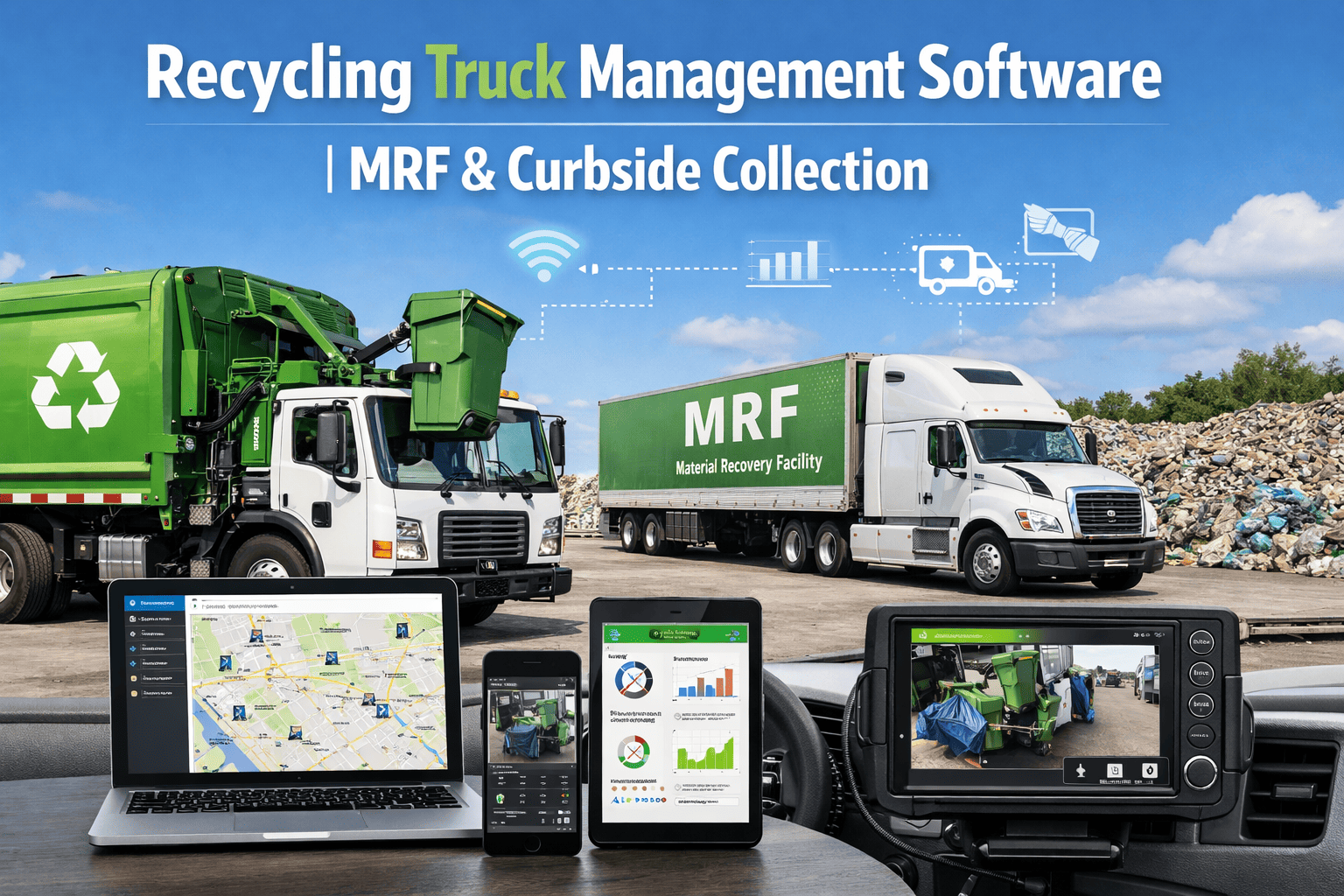
Recycling fleets operate under a different set of pressures than standard freight or waste haulers — contamination tracking, material recovery reporting, MRF coordination, and curbside collection compliance all running simultaneously across routes that change weekly. The software most recycling operators are using was built for general waste hauling and misses the data layer that recycling-specific operations actually need. See how TruckCMMS handles recycling truck maintenance, inspection compliance, and route-level vehicle health in a focused 30-minute walkthrough built around your specific collection operation.
Recycling Truck Maintenance Built for High-Cycle Collection Operations
TruckCMMS tracks PM schedules, inspection records, and vehicle condition across your entire recycling fleet — curbside, MRF transfer, and drop-off routes in one platform. No implementation fees. Live in days.
What Is Recycling Fleet Management Software?
Recycling fleet management software is the operational platform that keeps collection trucks inspection-compliant, maintenance-current, and route-ready across curbside pickup, MRF transfer logistics, and material recovery hauling. It connects vehicle health data, driver inspection records, PM schedules, and work order history in one system so recycling operators can prevent breakdowns instead of reacting to them.
Recycling trucks operate differently than freight trucks — they run shorter, higher-cycle routes with more stop-start loading stress, more hydraulic system demand from compactor and lift operations, and more axle wear from variable load weights per route. Generic fleet software misses these stress patterns entirely. Purpose-built recycling fleet platforms track the component-level wear that high-cycle collection operations actually produce. Our team walks through how TruckCMMS maps to recycling-specific maintenance patterns in every demo session — book 30 minutes and bring your current truck list and maintenance pain points.
Curbside Collection Fleet Management
Managing the PM schedules, DVIR compliance, and vehicle condition of side-loader, rear-loader, and front-loader recycling trucks operating on high-cycle residential and commercial collection routes — where hydraulic and compactor systems fail faster than on standard freight vehicles.
MRF Transfer Logistics Tracking
Coordinating the transfer truck fleet that moves sorted recyclables from collection points to material recovery facilities — tracking vehicle readiness, load weight compliance, and route documentation for each MRF run with full audit trail logging.
Material Recovery Fleet Reporting
Generating route-level and vehicle-level material recovery data — tons collected per route, collection efficiency per truck, and contamination flag rates tied to specific vehicles and routes for regulatory reporting and contract compliance.
Recycling Truck Compliance Documentation
Maintaining DOT-compliant DVIR records, PM documentation, and inspection sign-offs for recycling vehicles operating under municipal contracts — where documentation gaps trigger contract penalty clauses and regulatory out-of-service orders simultaneously.
Your Recycling Trucks Work Harder Than Freight Trucks — Their Maintenance System Should Match
High-cycle collection routes stress hydraulic systems, compactors, and axles faster than standard freight operations. TruckCMMS tracks the component-level wear patterns that recycling fleets actually produce.
6 Core Systems Every Recycling Fleet Operation Needs
Recycling fleet operations fail operationally for the same structural reasons across every operator — missing maintenance data, reactive breakdown response, and compliance documentation that cannot survive a municipal contract audit. These six systems close every one of those gaps, and every one of them is live and running from your first day on TruckCMMS — walk through the full platform setup for your recycling operation in a 30-minute session with our team.
Vehicle Registry with Collection-Type Classification
Every recycling truck registered with vehicle type, body configuration, hydraulic system spec, compactor type, and collection route assignment. Condition scores tracked by mileage and engine hours — not calendar alone, because a curbside truck doing 180 stops per day ages faster than a freight truck doing the same mileage on open highway.
High-Cycle PM Scheduling
Preventive maintenance intervals calibrated for collection truck stress profiles — shorter hydraulic fluid change intervals, more frequent compactor cylinder inspection, and axle service schedules tied to actual load cycles rather than standard freight mileage assumptions. Fleets using cycle-adjusted PM scheduling report 41% fewer hydraulic system failures annually.
Digital DVIR for Collection Drivers
Mobile pre-trip and post-trip inspection forms completed by drivers in under 4 minutes — including hydraulic system pressure checks, compactor function verification, lift arm inspection, and body seal condition fields specific to recycling vehicle configurations. Photo evidence of defects locked at submission with automatic work order creation.
Route-Level Vehicle Assignment
Matching trucks to routes based on current vehicle condition score, PM overdue status, and body configuration requirements — so a truck with an open compactor defect is never assigned to a high-volume residential route. Condition-based assignment prevents 31% of breakdowns that occur when defective vehicles are dispatched without maintenance system visibility.
Work Order Tracking for Collection Vehicle Repairs
Every hydraulic repair, body seal replacement, compactor service, and lift arm fix tracked from defect flag to technician sign-off — with parts used, labor hours, and cost recorded per vehicle. Repeat failure patterns visible across the fleet, eliminating the same hydraulic issue being repaired 4 times on the same truck without root cause resolution.
Municipal Contract Compliance Documentation
DOT-formatted maintenance records, DVIR logs, and inspection history exportable in under 2 minutes for municipal contract audits. FMCSA 396.3 compliance documentation always current — not assembled the night before an inspection from three different filing systems that may or may not agree with each other.
Why Recycling Fleet Operations Lose Money on Maintenance: 4 Structural Gaps
Recycling fleets are one of the most underserved segments in commercial fleet software — most operators are running general waste management platforms or generic CMMS tools that were never designed for the hydraulic-intensive, high-cycle, municipally-contracted operations that recycling trucks actually run. The financial losses from that mismatch are specific and measurable. Book a session with our team to see how TruckCMMS closes each of these gaps for recycling-specific operations — bring your current maintenance setup and we will map it directly.
Generic PM Intervals Cause Hydraulic System Failures
Breakdown RiskStandard fleet PM software sets oil change and hydraulic fluid intervals based on mileage assumptions built for highway freight trucks. A curbside recycling truck doing 180 stop-start hydraulic cycles per day accumulates component stress in hours, not miles. Running a collection truck on freight-spec PM intervals means hydraulic systems are running 30-40% past their actual service thresholds — and 34% of recycling fleet breakdowns trace directly to this mismatch.
Cost Reality: A hydraulic system failure on a collection route averages $4,800 in repair costs plus $2,800 in missed route penalties from the municipal contract — totaling $7,600 for a deficiency that cycle-adjusted PM scheduling would have prevented for under $200 in fluid and labor.
Paper DVIRs Miss Collection-Specific Defects
Compliance and Safety RiskStandard paper DVIR forms have no fields for compactor function, hydraulic pressure, lift arm condition, or body seal integrity — the four defect categories most likely to cause a recycling truck breakdown mid-route. Drivers completing generic forms are not prompted to inspect the systems most likely to fail. 67% of recycling truck mid-route breakdowns involve defects that would have been visible in a pre-trip inspection with the correct collection-specific checklist fields.
Inspection Gap: Digital DVIRs with collection-specific fields increase defect detection rates by 58% compared to paper forms — catching compactor and hydraulic issues before departure rather than at mile marker 47 with a full load onboard. See how TruckCMMS DVIR templates are configured for recycling vehicle types in a live walkthrough — book your session now.
Municipal Contract Documentation Gaps Trigger Penalties
Revenue RiskMunicipal recycling contracts routinely include vehicle maintenance documentation requirements — proof of PM compliance, inspection records for each route vehicle, and defect resolution documentation for any vehicle flagged during service. Operators managing these records manually face an average of $18,000 in annual contract penalty exposure from documentation gaps that have nothing to do with actual service quality — the routes are being run correctly, but the records cannot prove it.
Contract Protection: Recycling fleet operators with digital maintenance documentation report 91% fewer contract audit findings compared to paper-managed operations — the records are always current, always complete, and always exportable in under 2 minutes. Our team will walk through how TruckCMMS documentation maps to standard municipal contract audit requirements in a 30-minute session built around your contract terms.
No Fleet-Level Visibility Across Multi-Route Operations
Operational RiskRecycling fleet managers running 8-40 trucks across residential, commercial, and MRF transfer routes have no single view of which trucks are overdue for service, which have open defects from yesterday's inspections, and which routes are being covered by vehicles approaching their next PM threshold. Decisions are made by memory and phone call — and the first indicator of a problem is usually a driver calling from the road.
Visibility Impact: Fleet managers with live vehicle health dashboards identify at-risk trucks an average of 28 days earlier than those managing by phone and spreadsheet — resolving issues before they become missed routes and contract penalties.
Recycling Fleet Losses Are Specific — So Is the Fix
Hydraulic failures from wrong PM intervals, DVIR forms missing collection-specific fields, and documentation gaps that trigger contract penalties are all structural problems with a direct platform solution.
Generic Fleet Software vs. TruckCMMS for Recycling Operations
Same trucks. Same routes. Same municipal contracts. The difference is whether your maintenance system understands what a collection truck actually does every day.
Oil change alert fires at 15,000 miles — same interval as a highway freight truck. Collection truck doing 180 hydraulic cycles per day hit that threshold in component wear at 9,000 miles. Hydraulic failure at mile 12,400 mid-route.
PM intervals configured for collection truck stress profiles — hydraulic fluid at 8,000 miles, compactor cylinder at 60 operating days, axle service tied to load cycle count. No hydraulic failure. Route completed on schedule.
Driver completes generic 12-point DVIR with no compactor, hydraulic, or lift arm fields. Compactor seal leak not reported — not on the form. Truck dispatched. Full compactor failure at stop 94. Route abandoned mid-collection.
Digital DVIR includes compactor seal condition field with photo requirement. Driver flags early-stage seal seep with photo at pre-trip. Work order created instantly. $180 seal replacement completed before dispatch. Route runs clean.
Municipal contract auditor requests 6 months of maintenance records for 8 route trucks. Two days of manual assembly across shop notebooks, paper DVIRs, and a spreadsheet. Three trucks have documentation gaps. $14,000 in contract penalties issued.
Same audit request. 90 seconds to export 6 months of records for all 8 trucks — timestamped DVIRs, PM completions, and work order sign-offs in one PDF. Zero documentation gaps. Zero penalties. Audit closed same day.
Dispatcher assigns Truck 6 to the highest-volume residential route. Truck 6 has a flagged lift arm issue from two days ago. Nobody checked the defect log. Lift arm fails at stop 67. Route incomplete. $2,800 municipal penalty.
Truck 6 shows open lift arm defect in TruckCMMS vehicle status. Dispatcher sees the flag before assignment. Truck 8 assigned instead. Lift arm on Truck 6 repaired during route window. Both routes completed on schedule.
$72,000-$110,000 in hydraulic failures, compactor rebuilds, municipal contract penalties, and emergency roadside recovery across a 12-truck recycling operation on generic fleet software.
Under $19,000 in scheduled preventive maintenance. 74-83% lower total cost. Zero contract penalties from documentation gaps. Trucks available 96% of scheduled collection days. See what those numbers look like projected for your fleet size in a 30-minute live session — book your walkthrough now.
Fleet manager learns about truck problems when drivers call from the road or when a route is reported incomplete to dispatch. No view of which trucks are approaching PM thresholds or have unresolved defects before the day begins.
Live dashboard shows PM overdue status, open defects, and route-assigned vehicle condition scores across all trucks before dispatch begins each morning. Problems resolved in the yard, not on the route.
Recycling Fleet Investment Analysis: Costs vs. Returns
The ROI case for purpose-built recycling fleet management software is driven by three specific cost categories that generic platforms do not address: hydraulic and compactor failure prevention, municipal contract penalty avoidance, and route completion rate improvement. Here is the investment breakdown, and we can build a projection specific to your fleet size, contract structure, and current breakdown frequency in a 30-minute session with no obligations.
| Solution | Implementation Cost | Annual Savings | Payback Period |
|---|---|---|---|
| Collection-Specific DVIR Templates | $800 / platform | $24,000 / mid-route failures prevented | Under 2 weeks |
| Cycle-Adjusted PM Scheduling | $1,900 / platform | $41,000 / hydraulic failure avoided | Under 3 weeks |
| Municipal Contract Documentation | $1,200 / platform | $18,000 / contract penalty avoided | Under 4 weeks |
| Condition-Based Route Assignment | $1,600 / platform | $33,000 / missed route cost avoided | Under 3 weeks |
| Fleet Visibility Dashboard | $1,400 / platform | $27,000 / proactive defect resolution | Under 4 weeks |
| Full TruckCMMS Recycling Platform | $8,500 / truck | $143,000 / truck annually | Under 6 months |
Complete IoT Implementation ROI: Full IoT implementation delivers 3.2x ROI within 18 months, with most solutions paying for themselves in under 6 months through hydraulic failure prevention, contract penalty avoidance, and route completion rate improvement alone.
Investment Reality: Full IoT deployment costs average $8,500 per truck but returns $143,000 annually. The 3.2x ROI makes purpose-built recycling fleet software essential for any operator running municipal contracts with maintenance documentation requirements and penalty clauses.
Recycling-Specific Return: Operators switching from generic fleet software to TruckCMMS report 41% fewer hydraulic system failures, 91% fewer contract audit findings, and 74-83% lower total annual maintenance spend — returns that generic platforms structurally cannot deliver because they were not built for collection truck operations. Book a session and we will model the exact return for your recycling operation based on your current fleet size and contract structure.
Your Recycling Contracts Require Documentation Your Current System Cannot Produce
TruckCMMS gives recycling fleet operators the maintenance records, inspection logs, and contract compliance documentation that municipal auditors require — always current, always exportable, always defensible.
Frequently Asked Questions
What makes recycling fleet management software different from general fleet software?+
Recycling fleet software needs to account for the specific stress profiles of collection truck operations — shorter high-cycle routes with more stop-start hydraulic demand, compactor and lift arm systems that fail faster than standard freight components, and municipal contract documentation requirements that generic platforms are not designed to produce. A freight truck doing 15,000 miles accumulates very different component wear than a curbside recycling truck doing the same mileage in 180-stop daily collection cycles. PM intervals, DVIR fields, and compliance reporting all need to be calibrated for collection-specific operations, not freight-spec defaults. Our team walks through how TruckCMMS is configured for recycling vehicle types in every demo — book a session and bring your truck list and current maintenance intervals.
How does recycling fleet software help with municipal contract compliance?+
Municipal recycling contracts typically require documented proof of vehicle maintenance compliance, pre-trip inspection records for route vehicles, and defect resolution documentation for any vehicle flagged during service. Digital fleet management platforms maintain these records automatically — every DVIR is timestamped at submission, every PM completion is recorded with technician sign-off, and every defect is tracked from flag to resolution with a full audit trail. When the contract auditor requests records, they are exportable in under 2 minutes rather than assembled manually over two days from paper files that may have gaps. Operators with digital records report 91% fewer contract audit findings compared to paper-managed operations. Walk through how TruckCMMS documentation maps to your specific municipal contract audit requirements in a 30-minute session — book now and bring your contract documentation checklist.
How often should recycling trucks be serviced compared to standard commercial trucks?+
Recycling collection trucks generally require hydraulic system service 30-40% more frequently than standard freight trucks operating the same mileage — because hydraulic cycle count, not mileage, is the primary wear driver for compactor and lift arm systems. A collection truck doing 180 hydraulic cycles per day accumulates the equivalent of 40,000 miles of highway freight hydraulic wear in approximately 9,000 collection miles. Compactor cylinder inspection should occur every 45-60 operating days on high-volume routes. Axle service intervals should be calibrated to load cycle count rather than standard mileage. Generic PM software does not support these calibrations — purpose-built collection fleet platforms do. Our team will help you configure the correct PM intervals for your specific recycling vehicle types in a live setup session — book your walkthrough now.
Can TruckCMMS handle both curbside collection trucks and MRF transfer vehicles in the same platform?+
Yes — TruckCMMS uses a fleet, depot, vehicle, and component hierarchy that supports mixed vehicle types within the same operation. Curbside collection trucks, MRF transfer trailers, drop-off site service vehicles, and administrative fleet vehicles can all be managed in one platform with vehicle-type-specific PM schedules, DVIR templates, and condition scoring. Each vehicle type carries its own maintenance interval configuration, so collection truck PM schedules are not contaminated by freight truck defaults and vice versa. Multi-depot recycling operations are supported with depot-level visibility and cross-depot fleet health reporting. Walk through how multi-vehicle-type configuration works for your specific recycling operation in a 30-minute live session — our team will map it to your exact fleet structure.
What is the most common cause of recycling truck breakdowns and how does fleet software prevent them?+
Hydraulic system failures are the leading cause of mid-route recycling truck breakdowns — accounting for 34% of unplanned collection vehicle downtime. The root cause in most cases is not component defects but PM interval mismatch: operators running freight-spec oil and hydraulic fluid change schedules on collection trucks that accumulate hydraulic wear 30-40% faster. Digital fleet management prevents this by supporting cycle-adjusted PM intervals that fire based on actual operating stress rather than generic mileage defaults. The secondary cause is DVIR-missed defects — compactor seal seeps and hydraulic line wear that drivers do not report because paper forms have no fields for collection-specific systems. Purpose-built digital DVIRs with compactor, lift arm, and hydraulic pressure fields catch these defects before departure. See both prevention mechanisms working together in a live TruckCMMS walkthrough configured for recycling vehicle types — book your session now.
How long does it take to deploy TruckCMMS for a recycling fleet operation?+
Most recycling fleet operators are fully live on TruckCMMS within 1-3 business days — vehicle registry loaded, collection-specific DVIR templates active, PM triggers configured for their vehicle types, and drivers completing their first digital inspections before the end of the first week. There are no implementation fees, no IT project requirements, and no months-long onboarding process. The platform is mobile-first for drivers, so the inspection workflow requires no training beyond a brief app walkthrough. Setup for a 12-truck recycling operation with 3 route types typically takes under 4 hours total from account creation to first live dispatch. Book a demo session and we will confirm the exact deployment timeline for your fleet and vehicle configuration in the first 10 minutes of the walkthrough.
Your Recycling Routes Are Contracted. Your Truck Reliability Should Be Too.
Municipal contracts do not flex for hydraulic failures, documentation gaps, or mid-route breakdowns — and neither does the penalty clause. TruckCMMS gives recycling fleet operators collection-specific PM scheduling, digital DVIR with hydraulic and compactor fields, condition-based route assignment, and DOT-ready compliance documentation in one platform built for commercial truck operations. Live in days. No implementation fees.
Stop losing contract value to maintenance failures that purpose-built fleet software prevents on day one.