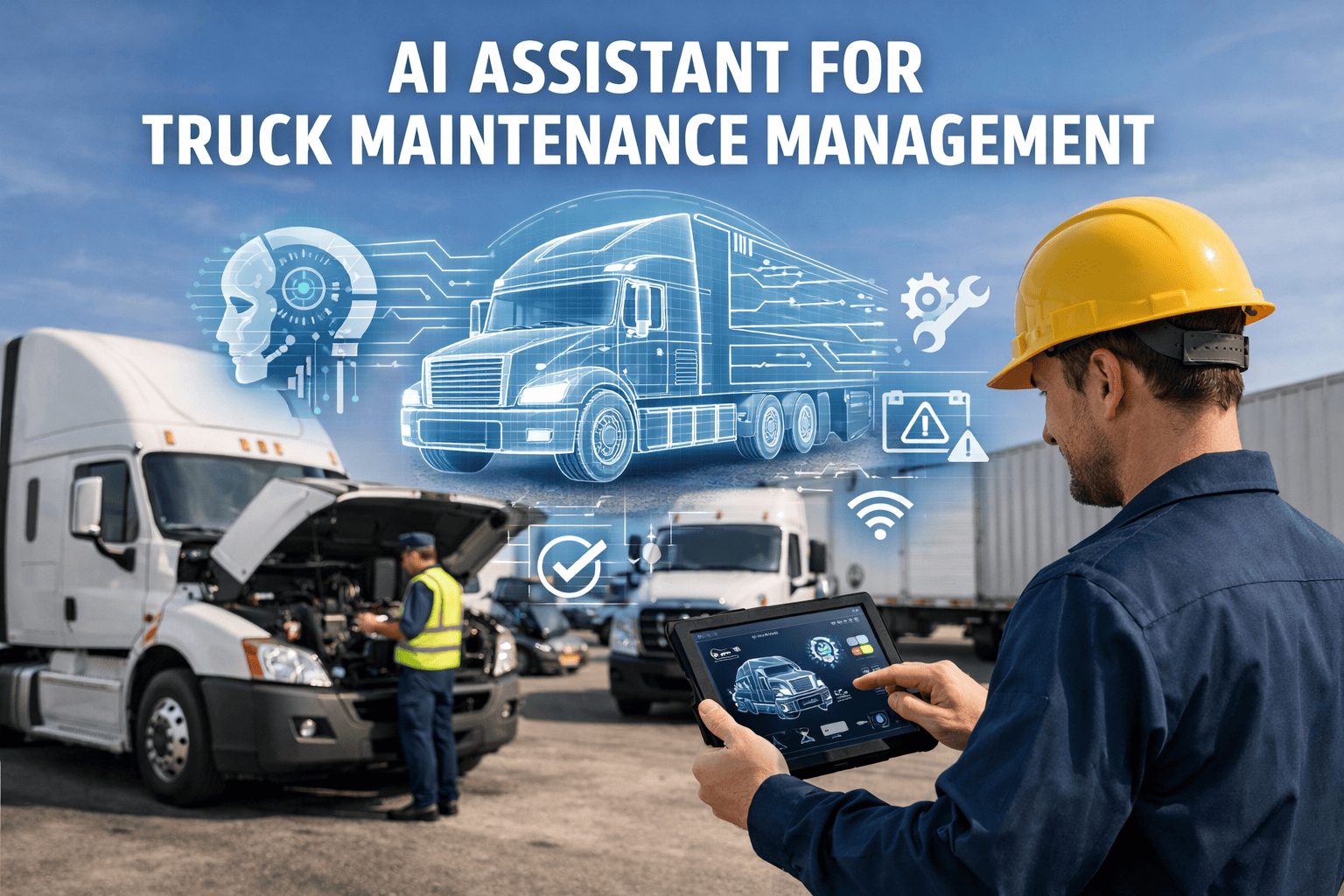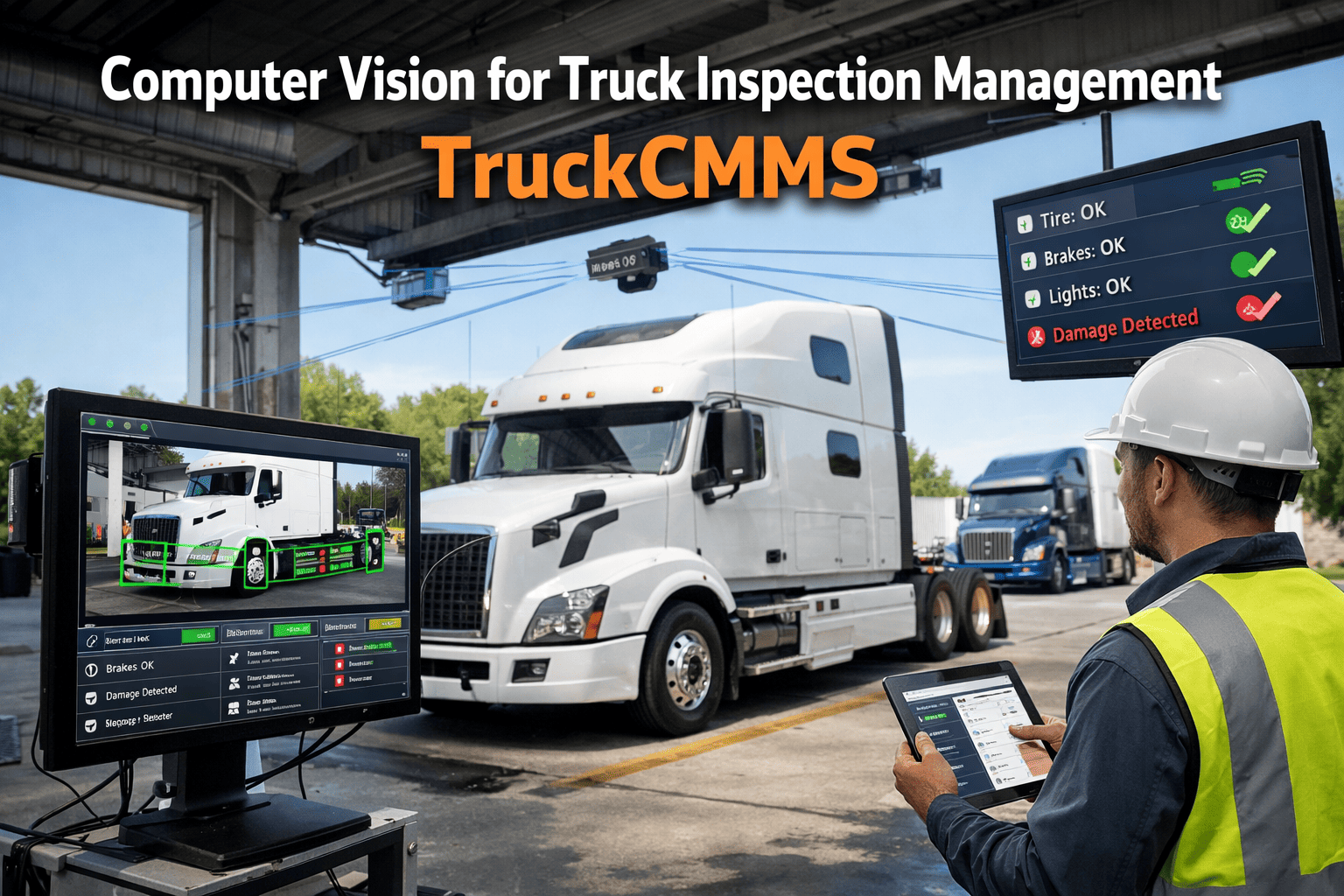
Computer vision is moving from warehouse automation into commercial truck inspection in 2026 — and the operators adopting it earliest are catching damage, defects, and safety hazards that manual visual checks systematically miss. A driver completing a paper pre-trip inspection averages 4 minutes across 18 items. A camera-assisted inspection with AI defect flagging covers the same 18 items in 90 seconds with photo evidence attached to every finding. The defect detection rate jumps from 61% on paper to 94% with structured digital inspection workflows. But computer vision only creates compliance value when every flagged finding is captured in a structured DVIR record, connected to a work order, and stored in an audit-ready maintenance history. TruckCMMS provides the inspection documentation backbone that makes computer vision truck inspection operationally complete — our team walks through how that works for your truck operation in every 30-minute live session.
Computer Vision Catches Defects. TruckCMMS Documents, Actions, and Proves They Were Fixed.
Digital DVIR with photo evidence, auto work order creation on every defect flag, and DOT-ready compliance records — the inspection documentation infrastructure computer vision truck inspection requires.
What Is Computer Vision Truck Inspection — and Why Does It Need Structured Documentation?
Computer vision truck inspection uses AI-powered cameras and machine learning algorithms to identify damage, defects, fluid leaks, tire conditions, and safety hazards during vehicle inspection — automatically flagging findings that manual visual checks frequently miss. The technology detects what human eyes skip under time pressure, fatigue, or low-light conditions on early morning pre-trip checks.
Computer vision finds defects. Structured CMMS documentation proves they were addressed. An AI camera that flags a cracked mudflap creates zero compliance value unless that finding is captured in a timestamped DVIR record, connected to a tracked work order, and stored in the vehicle's maintenance history. The inspection technology and the documentation system must work together — and TruckCMMS provides the documentation backbone that makes computer vision inspection operationally complete for DOT compliance. Our team shows exactly how that works in a 30-minute live walkthrough.
AI-Powered Damage Detection
Computer vision algorithms identify structural damage, body dents, cracked components, and fluid leaks at detection rates 30 to 40% higher than manual visual inspection — particularly in low-light depot conditions and high-fatigue early morning inspection windows.
Automated Photo Evidence Capture
Camera-assisted inspection captures timestamped photo evidence of every finding automatically — eliminating the documentation gap between a defect visually noticed and a defect properly recorded with supporting evidence for DOT compliance.
Defect Classification and Severity Scoring
Computer vision systems classify detected issues by component, defect type, and severity — generating structured defect data that flows directly into DVIR records and work order systems without manual transcription or dispatcher relay.
DOT Compliance Documentation Integration
Every computer vision finding must be captured in a DOT-compliant DVIR record with driver sign-off, photo evidence, and resolution trail to satisfy FMCSA 396.11 documentation requirements — the step that converts AI detection into legal compliance proof.
Inspection Technology Is Advancing Fast. Is Your Documentation Infrastructure Keeping Up?
AI cameras catch defects in 90 seconds. Without structured DVIR, work order automation, and compliance records to back them up, those detections create zero audit value and zero maintenance action.
6 Ways Computer Vision Is Changing Truck Inspection Operations in 2026
Computer vision truck inspection is not a single technology — it is a set of overlapping capabilities reshaping how defects are found, documented, and actioned across commercial truck operations. Each capability requires a documentation system to convert detection into compliance proof. Our team walks through how TruckCMMS connects to every computer vision inspection workflow for your truck operation in every live session.
Capability 1 — Pre-Trip Damage Detection at Scale
30-40% Higher Detection Rate Than Manual ChecksWhat It Does: AI cameras mounted at depot exit lanes scan truck exteriors as vehicles pass — identifying body damage, cracked lenses, missing components, and fluid evidence on the ground beneath the truck in under 90 seconds per vehicle
What Manual Inspection Misses: A driver completing a pre-trip under time pressure at 5 AM in a dark depot misses an average of 3 to 4 visual defects per inspection that a camera system would flag — each one a potential OOS order at a roadside stop
Documentation Requirement: Every AI-flagged defect must flow into a DVIR record with photo evidence and driver acknowledgment — creating the timestamped compliance trail that roadside inspectors and DOT auditors require
Computer vision pre-trip scanning is only as valuable as the documentation system that captures its findings. A camera that flags a cracked tail lens with no DVIR record creates the same compliance exposure as a driver who never looked at the tail lens. TruckCMMS captures every inspection finding with photo, timestamp, and driver sign-off — our team shows exactly how that DVIR workflow looks for your depot setup in every live session.
Detection Gap: Manual pre-trip inspections at commercial depots miss 39% of visible defects on average due to time pressure, fatigue, and lighting conditions. AI camera systems operating the same inspection protocol detect 94% of the same defects — a 33-point gap that represents uninspected trucks on every morning dispatch cycle.
Capability 2 — Automated Tire and Undercarriage Inspection
Tire Failures Are the #1 Cause of Commercial Truck Roadside OOSWhat It Does: Ground-level cameras and undercarriage scanners capture tire tread depth, inflation indicators, sidewall damage, and undercarriage fluid evidence automatically — inspection items that drivers physically cannot see during a standard walk-around without kneeling under the truck
Defect Frequency: Tire and brake issues account for 62% of all DOT roadside OOS orders on commercial trucks — the majority of which originate from defects visible at pre-trip inspection that were not documented because no structured inspection process required checking them
DVIR Connection: Automated tire and undercarriage findings must be captured in DVIR with photo evidence — both to create the work order that triggers shop service and to produce the compliance record that proves the defect was identified and addressed before the truck was dispatched
Tire and undercarriage defects found at depot by an AI system and documented in a DVIR become scheduled repairs. The same defects found by a DOT roadside inspector become OOS orders averaging $2,400 in service and $16,000 in compliance fines. TruckCMMS auto-generates work orders on every DVIR defect flag with photo evidence — our team walks through the defect-to-work-order flow for your truck types in every live session.
Prevention vs. Citation: A $280 tire service triggered by a DVIR defect finding prevents a $2,400 roadside OOS service call plus $16,000 DOT fine — a 66x return on a single inspection finding properly documented and actioned before dispatch.
Capability 3 — Fluid Leak Detection Before Dispatch
Fluid Leaks Invisible Until Roadside or Shop — Unless InspectedWhat It Does: Thermal cameras and ground-scanning AI systems detect fluid evidence — oil, coolant, hydraulic, and DEF — beneath parked trucks before dispatch, flagging active seeps that would not become visible symptoms for 50 to 200 miles of operation
Operational Impact: A coolant seep detected at pre-trip by AI camera and documented in DVIR costs $180 in hose fitting replacement. The same seep undetected for 150 miles produces a coolant warning light at highway speed, a $900 roadside service call, and a potential engine thermal event averaging $14,000 in repair cost
Documentation Chain: AI fluid detection finding captured in DVIR with ground photo evidence — work order created with component reference and severity — technician confirms source and completes repair — resolution logged against vehicle record for compliance history
The value of AI fluid detection is entirely dependent on the documentation and work order chain that follows the detection. A fluid alert that generates no DVIR record and no work order is operationally equivalent to no inspection at all. TruckCMMS ensures every fluid defect flag becomes a documented DVIR finding and an actioned work order — book a demo and our team walks through that workflow for your depot operation.
Cost Chain: Pre-trip AI fluid detection with DVIR documentation and same-day repair averages $220 per incident. The same fluid issue reaching roadside failure averages $4,800 — emergency service, tow, repair, and downtime combined. The 22x cost differential makes fluid inspection the highest single ROI item in AI-assisted truck inspection programs.
Capability 4 — Structural and Body Damage Documentation
Liability Documentation Requires Timestamped Photo EvidenceWhat It Does: Computer vision systems create timestamped, geolocated photographic records of all visible body damage at every inspection cycle — establishing a continuous condition baseline that documents when new damage occurred and differentiates pre-existing from route-acquired damage
Operational Value: A driver returning from a delivery route with new frame damage triggers an insurance claim. Without a departure condition record showing the truck was undamaged at dispatch, the claim timeline is unverifiable — adding dispute cost and claim delay to the repair cost
Compliance Value: DOT auditors reviewing maintenance records for accident-involved trucks expect documented condition histories that establish vehicle state at each inspection cycle. Timestamped photo DVIR records satisfy this requirement in a way paper checklists cannot
Structural damage documentation is where computer vision inspection creates the most direct liability protection value — and where the DVIR photo evidence requirement becomes a business-critical record rather than just a compliance checkbox. TruckCMMS stores photo-documented inspection records with timestamps for every truck — our team shows the damage history record in every live walkthrough.
Liability Value: Operators with timestamped photo DVIR records for departure condition resolve damage claims 68% faster and at 40% lower average settlement cost than operators relying on driver statements and paper checklists to establish vehicle condition at dispatch.
Capability 5 — Lights, Reflectors, and Safety Equipment Compliance
Lighting Defects Are the Most Cited DOT Roadside ViolationWhat It Does: AI camera systems verify lighting function, reflector presence, and safety equipment condition across the full truck exterior in a single automated scan — replacing the manual walk-around that consistently produces the highest rate of missed defects under time pressure
Citation Frequency: Lighting and reflector violations are the single most cited defect category in FMCSA roadside inspection data — accounting for 28% of all Level I inspection violations in commercial trucking. The majority are detectable at pre-trip inspection by any system that actually checks them
Cost of Missing: A single lighting violation at DOT roadside inspection generates a $500 to $2,400 citation plus an average 4.5-hour delay for roadside repair — entirely preventable with a 90-second automated lighting scan at the depot exit lane before dispatch
Lighting violations are the most preventable DOT citation category in commercial trucking — and the most frequently missed by manual pre-trip inspection under operational time pressure. TruckCMMS DVIR templates include all safety and lighting fields with photo evidence requirements — our team configures your inspection template during the live demo.
Compliance Math: A lighting defect caught at pre-trip by AI camera and fixed for $45 in bulb replacement prevents a $2,400 roadside citation and 4.5-hour route delay. The same defect caught during a DOT Level I inspection generates an OOS order if severity warrants — turning a $45 fix into a $16,000 compliance event.
Capability 6 — Post-Trip Return Condition Verification
Closes the Damage Attribution Gap Between RoutesWhat It Does: Computer vision post-trip scanning captures return condition at depot arrival — automatically comparing against the departure scan to identify new damage acquired during the route, documenting the finding with photo evidence before the next driver takes the truck
Operational Value: Without a post-trip AI scan, damage acquired on route sits undocumented until the next driver's pre-trip — creating attribution ambiguity, delay in repair actioning, and a gap in the maintenance history that DOT auditors flag as incomplete documentation
Work Order Trigger: Post-trip AI findings must flow immediately into work orders that schedule repair before the next dispatch — ensuring trucks do not complete a second route cycle with undocumented and unresolved damage from the first
Post-trip computer vision verification closes the damage documentation loop that manual inspection consistently leaves open — and the work order it generates is what converts an observation into a maintenance action with a resolution record. TruckCMMS auto-generates work orders from post-trip DVIR findings with photo evidence automatically — book a demo and our team shows exactly how that post-trip-to-work-order flow operates for your trucks.
Attribution Value: Operations using AI post-trip scanning with structured DVIR documentation resolve damage attribution disputes in under 4 hours on average — compared to 3 to 7 days for operations relying on driver statements and paper post-trip forms without photo evidence.
Every Computer Vision Finding Needs a Documentation System to Create Value
AI detection without structured DVIR, work order automation, and compliance records is a camera with no memory. TruckCMMS ensures every finding is captured, actioned, and audit-ready from the first inspection.
Manual Truck Inspection vs. Computer Vision with TruckCMMS Documentation
The trucks are identical. The routes are the same. The difference is whether defects are found before dispatch — or discovered at DOT roadside at $16,000 per finding.
Driver completes paper pre-trip in 4 minutes under depot time pressure — 3 lighting defects and a tire sidewall crack missed, truck dispatched, DOT roadside stop at mile 82, OOS order issued
AI camera scan at depot exit flags 3 lighting defects and tire sidewall crack in 90 seconds — DVIR records created with photo, work orders generated, repairs completed, truck dispatched clean
Coolant seep beneath truck not visible from standing height — undetected at pre-trip, seep becomes active leak at mile 150, roadside service call $900, engine thermal risk, 6-hour route delay
Ground-level AI scan flags coolant evidence before dispatch — DVIR photo captures seep location, $180 fitting replacement completed same morning, route runs on schedule with zero roadside event
Truck returns with new frame dent — no departure condition record exists, driver disputes route acquisition, insurance claim takes 11 days to resolve, $4,200 average disputed claim cost
Post-trip AI scan identifies new dent vs departure record — timestamped photo comparison resolves attribution in 3 hours, insurance claim filed same day, dispute cost eliminated
Auditor requests 90-day inspection records — paper DVIRs incomplete, photo evidence absent, 3 trucks with documentation gaps, $16,000 fine per violation, $48,000 total exposure
Audit notice received — complete photo-documented DVIR history exported for all trucks in under 2 minutes, timestamped findings with resolution records, zero violations cited
Driver verbally reports brake noise to dispatch — note lost in shift handover, defect unactioned for 4 days, brake fade develops, $3,800 emergency brake service at roadside
AI inspection flags brake component anomaly with photo — DVIR work order created in 60 seconds, $320 brake service scheduled same day, zero roadside event, zero emergency cost
$65,000 to $140,000 in OOS citations, roadside service calls, missed defect repairs, and compliance fines across a 10-truck operation running manual-only inspection processes
Under $16,000 in structured inspection and maintenance for the same operation — defects caught at depot cost a fraction of defects found at DOT roadside. See what your inspection operation looks like on TruckCMMS in a 30-minute live session with our team.
Ready to See How TruckCMMS Connects Computer Vision Inspection to Your Maintenance Workflow?
Digital DVIR with photo evidence, auto work orders on every finding, and DOT-ready compliance exports — the complete inspection documentation infrastructure your operation needs in 2026.
How TruckCMMS Provides the Documentation Infrastructure Computer Vision Inspection Requires
Computer vision systems detect defects in seconds. TruckCMMS ensures every detection becomes a documented DVIR finding, a tracked work order, a resolved maintenance record, and an audit-ready compliance trail. Our team walks through how TruckCMMS connects to computer vision inspection workflows for your specific truck count and depot setup in every 30-minute live session — come with your current inspection process and we will map the integration.
Custom DVIR Templates with Photo Evidence Fields
Fully configurable digital inspection templates that include photo evidence requirements for every defect-prone component — ensuring AI-flagged findings are captured with timestamped visual documentation, not just checkbox acknowledgment. 99% DVIR completion rate vs 61% on paper. Our team configures your first DVIR template live during the session.
Auto Work Order on Every Defect Flag
Any defect captured in DVIR — whether flagged by AI camera or driver observation — auto-generates a tracked work order with photo evidence, component reference, severity rating, and technician assignment in under 60 seconds. No verbal relay. No report lost in shift handover. 95% of findings actioned within 60 seconds of detection.
Component-Level Inspection History Per Truck
Every inspection finding stored at the component level — tire, brake, lighting, body, fluid system — with full photo history, defect recurrence tracking, and repair resolution linked against each vehicle record. Repeat defect patterns surface before the 4th repair on the same component.
Mobile-First Inspection for Drivers and Technicians
Drivers complete digital DVIR from mobile with AI-guided prompts and required photo upload in under 5 minutes — from any device, at any depot, with no paper form and no dispatcher relay. Inspection completion rates reach 99% within the first week of deployment. Our team demos the mobile inspection flow live during every session.
Real-Time Fleet Inspection Dashboard
Live visibility into inspection status, open defects, and unactioned findings across all trucks at all depots — before dispatch, not after a roadside OOS order. Fleet managers see every uninspected truck and every open work order in a single real-time view across the entire operation.
DOT-Ready Compliance Exports on Demand
Complete inspection history with timestamps, photo evidence, driver sign-offs, and resolution records — exportable in under 2 minutes for any DOT audit request. Covers all truck types, all depots, and any date range. Zero documentation reconstruction from paper logs. Our team exports a sample compliance record for your truck count in every live session.
IoT Investment Analysis: Costs vs. Returns for Computer Vision Truck Inspection
Computer vision inspection combined with structured CMMS documentation delivers returns from both higher defect detection rates and avoided DOT compliance costs. Here is how the investment breaks down per truck — and our team builds a custom ROI model for your truck count and current inspection defect rate in every live session.
| IoT Solution | Implementation Cost | Annual Savings | Payback Period |
|---|---|---|---|
| Digital DVIR with Photo Evidence Requirements | $500/truck + $35/month | $18,000/truck | Under 30 days |
| Auto Work Order on AI Defect Detection | $800/truck + $40/month | $22,000/truck | Under 2 weeks |
| Mileage-Triggered PM with Inspection Integration | $2,400/truck + $150/month | $41,000/truck | Under 3 weeks |
| DOT Compliance Dashboard and Photo Export | $1,200/fleet + $75/month | $27,000/fleet | Under 4 weeks |
| Component Inspection History and Pattern Tracking | $1,600/truck + $50/month | $34,000/truck | Under 3 weeks |
| Full IoT CMMS Deployment | $8,500/truck | $143,000/truck | Under 6 months |
Complete IoT implementation delivers 3.2x ROI within 18 months, with most solutions paying for themselves in under 6 months. Computer vision inspection compounds that return by raising defect detection rates — every additional defect caught at depot versus at DOT roadside saves $2,400 to $18,400 in avoidable costs per finding.
Investment Reality: Full IoT deployment costs average $8,500 per truck but returns $143,000 annually. The 3.2x ROI makes IoT investment essential for competitive truck operations. Computer vision inspection adds the detection layer — TruckCMMS provides the documentation layer that converts every detection into compliance proof and maintenance action. Our team runs a custom ROI projection for your operation in the first 10 minutes of every live session.
Questions About Computer Vision Inspection and Documentation for Your Operation?
Our team works with truck operators implementing AI inspection technology every day. Bring your current inspection process and defect rate to a 30-minute session — we will map exactly how TruckCMMS connects to your computer vision workflow and show you what your compliance records look like from day one.
Frequently Asked Questions
How does computer vision improve truck inspection accuracy and documentation?+
Computer vision improves truck inspection accuracy by detecting defects that manual visual checks miss under time pressure, fatigue, and low-light depot conditions — achieving 94% defect detection rates versus 61% on paper DVIR forms. It improves documentation by capturing timestamped photo evidence of every finding automatically, eliminating the gap between a defect visually noticed and a defect properly recorded with supporting evidence. For compliance purposes, the photo evidence must flow into a structured DVIR record with driver sign-off — which is what TruckCMMS captures for every inspection finding. Our team walks through how that inspection-to-documentation flow works in every live session.
Can AI-powered damage detection integrate with digital DVIR for commercial trucks?+
Yes. AI damage detection systems output structured defect data — component, defect type, severity, and photo evidence — that flows directly into digital DVIR records when connected to a CMMS platform with configurable inspection templates. TruckCMMS accepts defect inputs from inspection workflows and creates complete DVIR records with photo evidence, driver acknowledgment, and timestamp for every finding. The DVIR record is what satisfies FMCSA 396.11 documentation requirements — the AI detection is the input, the DVIR is the compliance output. Book a demo and our team walks through the AI-to-DVIR integration for your truck types.
How does automated visual inspection reduce missed defects on truck pre-trip checks?+
Automated visual inspection reduces missed defects by removing the human factors that cause manual inspection failures — time pressure, fatigue, lighting conditions, and inconsistent coverage. AI camera systems scan the same inspection protocol on every truck on every cycle without variation, achieving consistent 94% detection rates that manual inspection cannot replicate under operational conditions. The 33-point gap between AI and manual detection represents defects that leave the depot on active routes, generating OOS orders and roadside repair costs that structured inspection would have caught before dispatch. Our team shows what that detection gap costs in your operation during the live ROI walkthrough.
What role does computer vision play in DOT compliance documentation for truck fleets?+
Computer vision plays the detection role in DOT compliance — identifying defects that require documentation, repair, and resolution records. The compliance documentation role belongs to the DVIR and CMMS system that captures each finding with timestamp, photo evidence, driver sign-off, and resolution trail. FMCSA 396.11 requires written inspection reports for every commercial vehicle every operating day — and DOT auditors expect photo-documented records that show what was found, when it was found, and how it was resolved. TruckCMMS produces those records automatically for every inspection finding. Our team exports a sample DOT compliance record in every live demo so you can see exactly what audit documentation looks like.
How is computer vision truck inspection different from standard DVIR processes?+
Standard DVIR is a driver-completed inspection documentation process — it captures what a driver reports finding during a manual walk-around. Computer vision inspection is an AI-powered detection layer that precedes or augments the DVIR — identifying defects the driver may not have noticed and providing photo evidence that strengthens the DVIR record. The two systems are complementary: computer vision raises detection accuracy, digital DVIR converts detections into compliance documentation. Operations running computer vision without structured digital DVIR are detecting defects with no documentation chain. Operations running digital DVIR without computer vision are documenting what drivers notice, not what AI would find. Our team walks through how both layers work together for your trucks in every live session.
How is TruckCMMS positioned to support computer vision truck inspection workflows in 2026?+
TruckCMMS provides the inspection documentation infrastructure that computer vision truck inspection requires to deliver compliance value — configurable digital DVIR templates with photo evidence fields, auto work order creation on every defect flag, component-level inspection history per vehicle, and DOT-ready compliance exports in under 2 minutes. As computer vision inspection becomes standard in commercial trucking through 2026, the operators who get full value from the technology are the ones with structured CMMS documentation systems that capture, action, and prove every AI-detected finding. TruckCMMS is that documentation system, deployable in a single day at no cost. Book a 30-minute session and our team walks through how TruckCMMS positions your specific operation for computer vision inspection in 2026.
AI Cameras Catch Defects in 90 Seconds. TruckCMMS Makes Sure Every One of Them Gets Fixed and Documented.
Computer vision inspection raises defect detection rates from 61% to 94%. TruckCMMS converts every detection into a DVIR record with photo evidence, an auto-generated work order with technician assignment, and a DOT-ready compliance trail exportable in under 2 minutes. The full inspection-to-compliance chain in one platform, for every truck you operate, live in a single day with no implementation fees.
Defects found at the depot cost $45 to $320 to fix. The same defects found at DOT roadside cost $2,400 to $18,400. Every inspection gap is a cost gap.